
Maybe you’ve watched a tortoise head-butt someone’s black shoe and thought, “Okay, they hate that color.” It feels obvious in the moment. Before we lock that in, let’s slow down and look at the pattern behind those big reactions. To get why a calm turtle suddenly decides to ram a boot, you have to look at how they handle two specific problems: trapping body heat and spotting rivals.
From Anecdote to Evidence
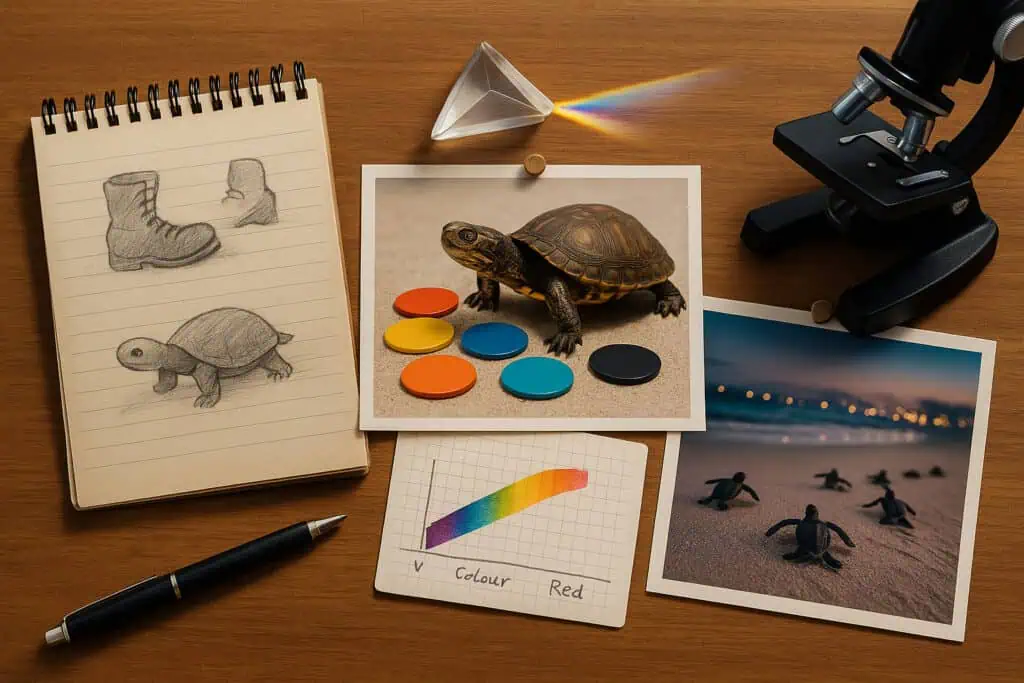
People have watched turtles and tortoises for a long time, and stories spread fast. Over the years, many keepers noticed tortoises ramming black shoes or chasing dark buckets, so the tale grew that turtles “hate black.” These reports are common in forums and social posts, and even some blogs echo them, but they are anecdotes rather than controlled tests.
Meanwhile, scientists have been busy studying how turtles see. Decades of work show that turtles have good color vision, with several types of cone cells (and oil droplets) that help them distinguish colors, including short wavelengths like blue/UV and longer wavelengths like red. This research is solid and repeatable.
Researchers also looked at behavior around light. Sea turtle hatchlings, for example, don’t run away from “black”; they head toward the brightest horizon (usually the ocean) and can become lost when artificial lights are brighter than the sea. That finding goes back over a century and has been confirmed many times.
Finally, several studies tested color preferences in tortoises and sea turtles. Results vary by species and situation, but many individuals show interest in yellow or red objects (often because they look like food). Even so, the same animals may ignore color when something smells tasty or moves in a certain way.
What Actually Drives Reactions

Before we proceed, let us be clear that turtles don’t hate a color the way people “hate” something. Instead, they are reacting to a specific set of survival triggers.
A flat black object can appear to be a hole or a shadow (contrast). A shiny black boot can look like a rival or simply grab attention (motion/Shape). And a black surface in the sun can be uncomfortably hot (heat). So the reaction is to the situation, not to the color alone.
Color Vision, Not Color Hate
Turtles are visual animals with multiple cone types; they discriminate colors and even use UV cues. Because their eyes handle color well, a single color rarely explains a behavior on its own. Brightness and contrast often overpower color, especially outdoors. That’s why hatchlings use the bright horizon rather than a specific hue to find the sea.
When Darkness Draws Attention
While it looks like pure aggression, the behavior is actually a complex response to three distinct environmental cues.
- Heat factor: Black absorbs heat. On sunny days, black objects can get very hot, which animals may avoid or investigate carefully. Avoidance here is sensible, not emotional “hate.”
- High-contrast silhouettes: A dark shape against a bright background is eye-catching. Some tortoises may approach, nudge, or even ram it, especially territorial males in breeding season.
- Mistaken identity: Dark blobs can resemble shade, burrows, or even other animals. The same object can cause fear in one turtle and curiosity in another.
Species and Setting First
A red-eared slider in a pond, a desert tortoise in a yard, and a loggerhead hatchling on a beach live in very different worlds. Unsurprisingly, their reactions differ. Some tortoises show a strong interest in yellow/red objects linked to food. Sea turtle hatchlings cue on light intensity and direction, not “blackness.” Therefore, you’ll see mixed behavior across species.
Frequently Asked Questions
Do turtles actually see black and other colors?
Most turtles see many colors, not just light and dark. Their eyes have color-sensing cells, so they can notice blues, greens, reds, and dark shades like black.
Why do turtles hate the color black on boots or buckets?
Strong contrast, heat, and movement make black things stand out. A black boot in bright sun can look like another shell, a shadowy hole, or just a hot, strange object—so some turtles charge, others avoid. It’s about how it looks and feels, not true “color hate.”
What colors do turtles prefer?
Species and situation matter. Many turtles pay extra attention to yellow and red, especially when those colors mean food. Smell and motion can matter more than color, and each turtle can be different.
Do sea turtles avoid black when finding the ocean?
Hatchlings head toward the brightest, lowest horizon. Street and building lights can fool them, which is why shielding or turning off lights helps. Color by itself isn’t the main guide.
Can turtles tell colors apart in tests?
Simple training tests show many turtles can choose one color over another. They use color when it helps them find food or the right direction.
If it’s not hate, why do these stories keep spreading?
Big reactions are easy to remember. A tortoise ramming a black boot makes a great story, but one event isn’t proof; most behavior comes from contrast, light, species differences, and learned habits.
Bonus: fun facts related to turtles and color

Turtles’ “red vision” links them to birds
A gene involved in red vision and color display is active in both birds and turtles, hinting at deep evolutionary ties in color vision. That’s pretty cool, and it explains why many turtles notice warm colors so well.
Color can shape plastic mistakes at sea
Some sea turtles swallow floating plastic when its color and texture mimic prey like jellyfish or algae. Sadly, that means certain colors and looks raise the risk, which is another reason to keep plastic out of the ocean.
Blue isn’t always best underwater
Recent work on post-hatchling hawksbills suggests color choices can shift with depth, background, and prey type. In shallow water, the “best” color can change, so simple rules rarely fit every species or setting.
Final word
The shoe story doesn’t prove a dislike. It points to a repeatable pattern. That shift matters more than the myth: it turns a one-off video into a predictable kind of scene. With that in mind, “turtles hate black” reads like a slogan, not an explanation.
Interested in exploring similar posts? Visit The Science of Everyday Life hub for more!