
”It is just a cover for a missing or wounded eye,” someone would tell you if you ask them why pirates wear eye patches. Ironically, the dark eye patches have more to do with light. Before we answer the question, keep three ideas in mind: “dark adaptation,” the hand-off between rods and cones, and the way sailors moved from bright deck to shadowed spaces below.
Fiction vs. Physics

Long before Hollywood, eye coverings were everyday medical tools for people with injuries or infections, and later for treating children with a “lazy eye.” Sailors and soldiers, who faced splinters, shots, and flying debris, certainly had more eye trauma than most. Yet the pop-culture picture of every buccaneer in a patch grew far beyond the historical record. Historians note that the familiar pirate look was sharpened by fiction, especially nineteenth-century storytellers, and that hard evidence for widespread patch-wearing on pirate crews is thin. Historians outline how popular images outpaced documentation and explain that patches mainly covered lost or damaged eyes, rather than serving as a universal tactic at sea. Likewise, Britannica highlights how novels like Treasure Island shaped the modern pirate stereotype and notes the lack of evidence for routine eyepatch use.
Because of that gap between legend and logs, the habit persists as a curious mix of medical history and Hollywood embellishment.
Two-Light Problem

The Photochemical Lag
Walk out of noon sun into a dark cabin, and the world turns to syrup. First, the cones that handle color at high light levels are “bleached,” and sensitivity drops. Then, as minutes pass, rods take over, making dim spaces visible again. This slow ramp-up is called dark adaptation, and it is why pilots and mariners protect their eyes before a night watch. The American Academy of Ophthalmology explains that rods and cones switch roles as light falls, and that night vision improves only after the retina resets. Because this reset costs time, a simple cover over one eye could keep that eye ready for shadows while the other handled sunshine, turning a handicap into a tactical reserve.
The “30-Minute Gap.”
Dark adaptation is not instant. Flight and safety handbooks repeat the same timing: cones recover in minutes, but rods need roughly half an hour to reach peak sensitivity. The FAA’s official handbook tells pilots to plan for about 30 minutes for full rod-based night vision and to shield their eyes from bright lights or start over. When a boarding party had to drop below deck and fight among lanterns and moon-slivers, an eye that skipped this 20–30 minute wait would be a huge advantage. So, although it looks like a simple band of cloth, the patch functions as a cheap, portable “time machine” for the retina.
Modern Myth-Testing
Television is not a lab, but controlled demos can test a mechanism. In their 2007 “Pirate Special,” MythBusters ran obstacle courses with light-adapted eyes versus one eye kept covered beforehand. With the covered eye, tasks in the dark were completed far faster. Because historians have not found period manuals prescribing the trick, the show rated the claim “plausible,” not “confirmed,” but the performance bump matched the physiology. This blend of science and practice keeps the theory alive because the biological mechanism makes perfect sense, regardless of the historical paperwork.
Naval Doctrine
Naval lookouts were formally trained to protect their night vision: avoid stray glare, prepare their eyes for low-light conditions before watch, and keep them adapted on station. A World War II U.S. Navy lookout handbook even summarizes the dark-adaptation technique and the need to shield eyes before stepping into darkness. That instruction confirms that professional mariners have long understood the principle, even if the specific pirate tactic remains a legend.
Frequently Asked Questions

Did pirates only wear them for injuries?
Eye injuries absolutely happened at sea, and some individuals wore a patch for that reason. However, the mechanism that keeps this question alive is the light-to-dark delay in the retina. Because a covered eye avoids bleaching and keeps rod chemistry ready, a patch could double as a tool for quick vision shifts. That nuance bridges the gap between the medical reality and the tactical myth.
Would swapping the patch be confusing?
Sudden swaps do take a moment, since eyes move together and the brain favors smooth binocular input. Even so, once one eye is dark-adapted, uncovering it in shadow gives immediate scotopic detail while the light-adapted eye lags. The trick is about timing and context, not constant flipping.
Didn’t lanterns make below-deck spaces bright?
Lanterns and portholes helped, but many compartments remained dim by day and very dim at night. Because rods are exquisitely sensitive, tiny differences in background light can decide whether you pick out a shape or miss it. That is why night-watch training tells sailors and pilots to preserve adaptation and shield their eyes before entering bright spaces.
Is red light the same as a patch?
Red light is used to preserve dark adaptation because rods are less responsive to longer wavelengths than to green-blue wavelengths. However, red light still adds photons and can cut contrast or distort colors. A patch simply blocks light, allowing the covered eye to remain fully adapted. Both methods work on the same principle, just with different tradeoffs already spelled out in safety manuals like the FAA’s.
Did navies officially teach this?
Modern manuals teach protecting both eyes, using dim lighting, and avoiding glare. Some services used red goggles before night duty. While that proves the principle, historians still do not have direct orders saying “wear an eyepatch to keep one eye dark-adapted” in the Age of Sail. The scientific mechanism fits; the documentary proof for pirates remains limited.
Bonus: fun facts
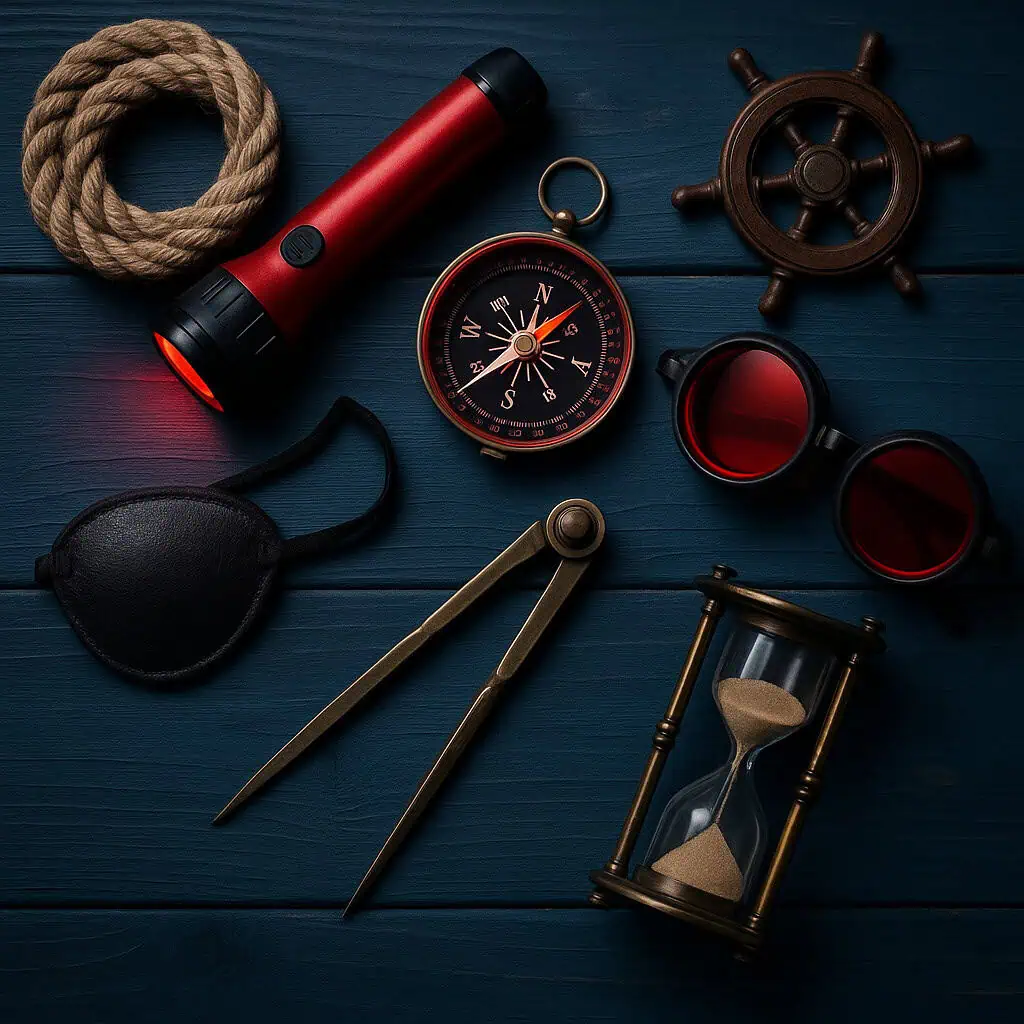
Beyond the high seas, the science of single-eye occlusion appears in modern medicine and aviation.
- Pediatric eye care still uses eye patches, but for a very different goal: training a weaker eye in amblyopia by covering the stronger one for set hours per day. The National Eye Institute describes this approach and its evidence.
- In aviation and at sea, crews protect their night vision before a shift because a bright flash can reset rod sensitivity. That operational habit echoes the same biology that keeps the legend alive despite the lack of official naval logs.
- Human eyes run on two main systems. Cones carry detail and color in daylight; rods carry faint, grainy shapes at night. The hand-off between them explains why moving from sun to shadow feels like hitting a wall.
- Some historical figures did wear a patch after injury, which likely fed the trope. Fiction then amplified the look until it became “standard pirate gear,” even when crews varied widely.
Final Word
When you take notice of the body’s slow gearshift between light and dark, the eyepatch stops being just a costume piece and starts looking like a low-tech vision tool.
If a single strip of cloth can turn the lights on faster in one eye, what other everyday hacks are hiding in plain sight because we have not looked at the mechanics first?
Interested in exploring similar posts? Visit The Science of Everyday Life hub for more!