
People often think golfers shout because a ball veers off course and might hit someone, but the real reason is more systematic than an “oops.” If you’ve ever searched “why do people yell four in golf,” you’re uncovering an old safety routine tied to the forecaddie role and a brief Scots interjection that became standard in the sport. We’ll unpack the mechanics first, then name what it is and why it matters.
Roots and early echoes
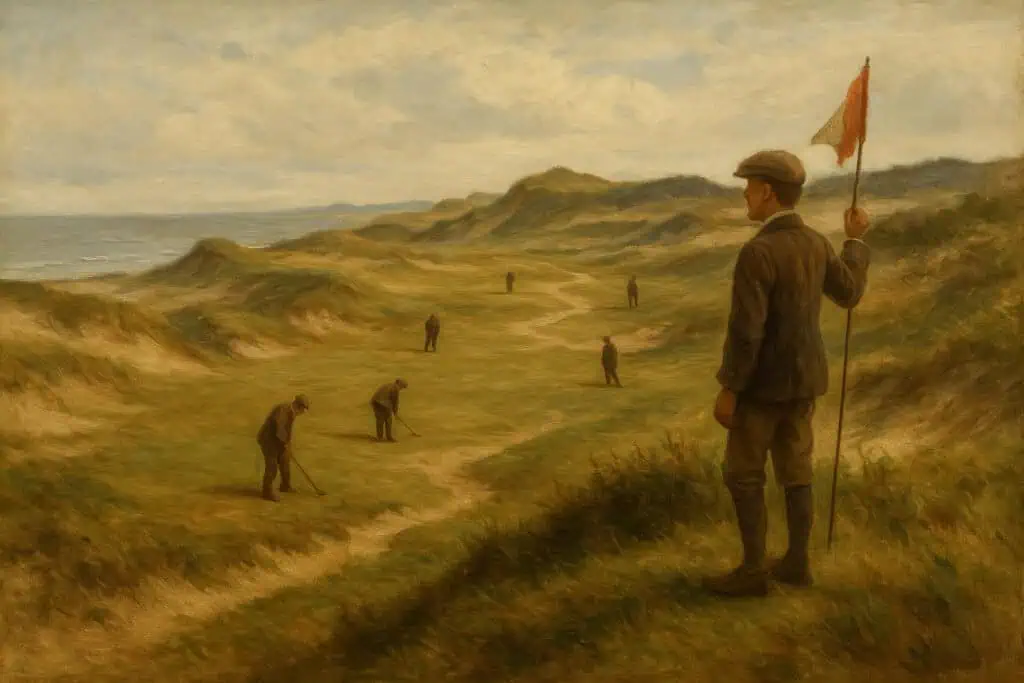
Before modern tools, golf was played on messy links where sightlines and fairways overlapped. Players relied on spotters ahead to track balls and prevent mishaps. The forecaddie, stationed out in front, was a key part of this safety system—a role still defined as the person indicating where shots finish.
Language scholars note that a short Scots cry appeared in golf by the late 19th century. Its exact path is debated, but it entered from Scotland. As golf formalized, warnings moved from custom to etiquette, where governing bodies still require them today.
Mechanics of the shout

A human alert chain
After you hit the ball, it leaves before most can track its path. Teammates lose sight, and those ahead can’t see your swing. A sharp call travels faster than recognition, tells everyone to duck, and provides a split-second warning. That chain—strike, sound, safety—shows why golfers yell fore: to trigger a real-time alert when a shot goes astray.
Angles and blind spots
Courses have blind spots from doglegs and mounds. A short, distinct call carries across hills and wind, alerting anyone in the likely flight zone, even if unseen. The purpose—alerting a wedge of space—comes first; the familiar word follows.
Speed, time, and voice
Modern balls fly fast, so sight isn’t enough for safety. A shouted cue reaches people sooner than a pointing gesture and is universally understood. That’s why rules stress immediate warning—a clear, at-once alert echoed by the R&A and U.S. guidance.
Custom turned protocol
Golf prizes self-policing. Over time, the shout became protocol: if your shot might reach someone, warn them. This standard appears in official resources, from FAQs to glossaries. A spoken alarm unites players—explaining why fore is heard whenever a ball strays.
Frequently Asked Questions

Is it “four” or “fore”?
The sound you hear is a clipped interjection used on the course; it’s spelled fore in every reputable dictionary and rule reference. Search trends explain why many people type “why do people yell four in golf”—it’s how the ear hears it—but written guidance sticks with fore.
Is there a penalty for not shouting?
Guidance focuses on conduct. There’s no routine stroke penalty, but committees can act if behavior violates the game’s spirit.
Where should the call be aimed?
Project your voice toward the ball’s path and add a signal if possible. Ensure maintenance staff notice—if unsure, call again or wave.
Did the word come from “before/afore” or “forecaddie”?
Both origins are acknowledged. Regardless, the practical function stayed the same.
When should the shout happen?
It must be immediate—right after impact, as soon as you know someone might be in the ball’s path. The word carries the warning, but timing is what matters.
Bonus: quick fun facts
Here are a few quick related bits. These sharpen your feel for the tradition without repeating earlier points.
- The helper still exists. You’ll still see tournament crews acting like modern forecaddies—ball spotters and marshals who extend the alert chain forward. The role’s name lives on in the lexicon, too.
- Interjections are tools. Languages stash special “alert” words for specific risks; golf’s interjection sits alongside other targeted cries in everyday life.
- Etiquette scales up. From muni tracks to major championships, the same expectation applies: if a shot could endanger someone, warn immediately. That continuity, from local leagues to governing bodies, explains why the warning sounds exactly the same whether you are at a municipal track or the Masters.
Final word
Once you see the shout as a system, not a superstition, the course looks different. That quick word is the cheap, universal tech that connects strangers across 400 yards of grass and wind—one second of sound that turns a solitary swing into shared responsibility. The next time a ball takes a hard turn and a short cry rides the breeze, notice how fast a whole fairway reacts. Then ask yourself: what other parts of the game—on a course or off it—work best when everyone agrees to speak up before anyone gets hurt?
Interested in exploring similar posts? Visit the Hidden Histories & Origins hub for more!