
A turban is more than just a religious symbol or fashion choice. Its full story involves rarely mentioned concepts like kesh, ʿimāma, the physics of desert heat, and even modern uniform codes such as AR 670-1. These factors intersect in unexpected ways, making a single wrap convey many meanings at once.
Routes cloth and continuities

Before we answer the big question, it helps to know where turbans show up. Turbans appear in art, texts, and dress across North Africa, South Asia, and beyond. You’ll see different names (dastār, pagri, imama, cheche, safa) and each region wraps and ties them in its own way. In South Asia, for example, the pagri varies by state, community, and occasion; in the Sahara, long wraps shield face and head; and in the Middle East, a turban may sit over a cap.
Historians and curators have tracked turbans for centuries in both daily life and ceremony. For a broad overview, see the neutral summary on Britannica’s entry on the turban. For a sense of real objects and materials, the Metropolitan Museum lists period pieces like an Indian silk Turban (1800–1940), which shows how long, fine cloth is used to create height and structure. These sources show the range and craft without telling us the “why” just yet.
The Five Core Motivations
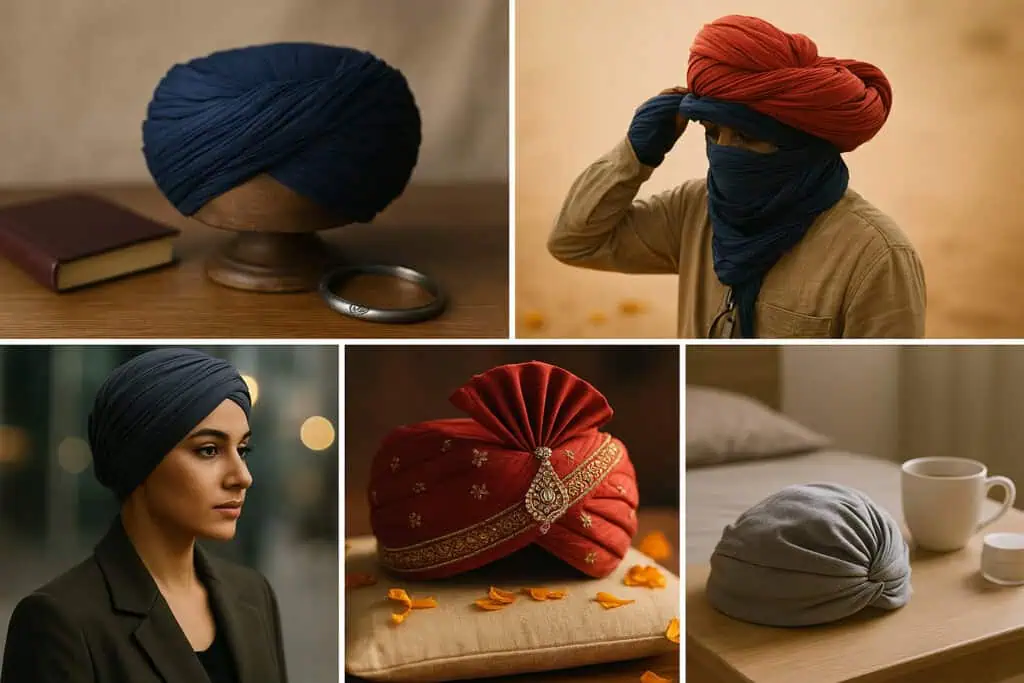
There isn’t a single answer to why people wear turbans. Still, the main reasons fall into a few simple buckets.
Visible Vows and Belonging
For many Sikhs, the turban is tied to faith, identity, and a vow to keep hair uncut (kesh). It’s not a casual hat; it’s part of a visible commitment, worn by men and, in some communities, women.
In Muslim cultures, some men wear a turban (often called ʿimāma) as a respected practice with deep roots. Classical sources describe it as recommended rather than strictly required.
So, within faith, the turban can show devotion, continuity, and community. But remember: the meaning changes across groups, and the rules are not the same for everyone.
Heat, Dust, and Labor
People also wear turbans for simple, practical reasons: sun, sand, wind, and dust. Desert and steppe cultures have long used long wraps to cool the head, shade the neck, and cover the mouth during storms. If you picture the Tuareg of the Sahara, you’ll recall the deep-indigo cloth and full face wrap. National Geographic describes how these headwraps blend function and style, helping people move and work in extreme heat and glare.
Honor Rank and Celebration
Turbans can also mark rank, respect, or special moments. In parts of the Indian subcontinent, a turban may be offered to honor a guest or worn at weddings and festivals. Museums hold many examples of rich fabrics, jeweled bands, and elaborate folds that signal formality or celebration.
Personal Taste Public Signal
Because wrapping styles and colors vary so much, turbans naturally become personal style. In cities worldwide, you’ll see fashion turbans, headwraps, and creative folds that match outfits or send a message. Here, meaning is lighter: it’s about taste, culture, family tradition, or simply what feels good to wear.
Comfort During Hair Loss
Sometimes the reason is health. People going through chemotherapy or other treatments may choose turbans or scarf wraps for comfort, warmth, and privacy. The American Cancer Society even offers how-to tips for scarf-tying and mentions turbans as a simple option for thinning or lost hair.
Frequently asked questions
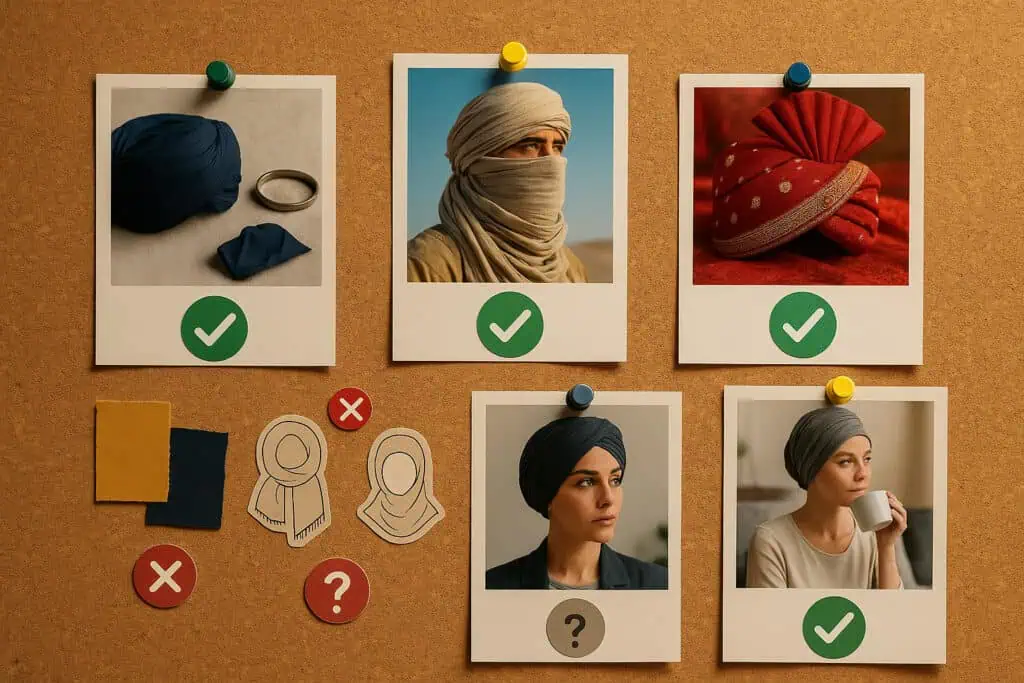
Do all Sikhs wear turbans?
While the turban is considered essential in Sikh practice, personal and global observance varies. For insight into its meaning, consult the Sikh Coalition’s overview of identity and articles of faith.
Is a turban the same thing as a hijab?
The two serve different purposes: a turban is a wrapped headcover worn by many communities (men and women in different settings), while hijab usually refers to women’s modest dress practices in Islam, often a headscarf that covers the hair and neck.
Are turbans only religious?
Turbans are not just religious; custom and climate play equal roles. Many wraps offer sun protection, dust control, hair care, or reflect local styles. Historically, Western fashion also adopted turbans, from 18th-century salons to early 20th-century couture. The Met’s essay on Safavid fashion shows how meanings and aesthetics travel between cultures.
Do only South Asians wear turbans?
Ethnographers and museum records show wrapped headwear among many peoples. In the United States, Seminole and Miccosukee leaders traditionally wear distinctive cloth turbans during important ceremonies. Therefore, wearing turbans reaches far beyond one region.
Are turbans “mandatory” in Islam?
Historical norms are diverse. Head-covering customs for Muslims vary by school, region, and era, and scholars typically describe the turban as a recommended practice rather than a universal legal requirement.
Do colors and styles always mean the same thing?
Local codes are flexible. A color may signal celebration in one community and mourning in another; a knot that marks scholarship in one era could become fashionable in the next. When in doubt, it’s best to ask someone about their own practice rather than assume a single “key.”
Bonus Facts

- It’s more cloth than you think. A traditional turban can use many feet of fabric. Long cloth adds height, stability, and the layered look seen in portraits and museum pieces.
- Work and weather shape the wrap. Hot, dry regions often favor bulkier, more breathable layers; windy regions may favor tighter folds. That’s why desert wraps look different than city styles in humid climates.
- Uniform rules are changing. In the United States, both the military and police departments have updated policies to allow religious head coverings, including turbans, so people can serve without giving up their faith practices. The U.S. Army announced a key policy shift in 2017, and later updates clarified approvals under AR 670-1.
- Not all headwraps are “turbans.” West African gele, Middle Eastern keffiyeh, and South Asian pagri/safa are part of a broader family of head coverings. Each has its own rules, folds, and social meanings.
- Respect goes a long way. In many gurdwaras (Sikh houses of worship), visitors cover their heads as a sign of respect, often with a simple scarf or bandana provided at the door. When in doubt, ask a host how to do it right.
Read the Wrap
To understand headwear, pause and observe: fabric, color, and setting share meaning. Notice context, ask questions, and replace assumptions with curiosity; this shift leads to deeper conversations.
Interested in exploring similar posts? Visit the Cultural Rituals & Society hub for more!
Very interesting, thank you. I imagine turbans were/are essential in hot climate and desserts.