
Short Answer: Why do people want what they can’t have? Because limits flip on several mental switches at once: scarcity makes things seem more valuable, threats to our freedom spark “I’ll show you” push-back (reactance), and our dopamine system chases uncertain rewards. Add distance and fantasy, and desire can swell even if the payoff would be small.
A brief history of why people want what they can’t have
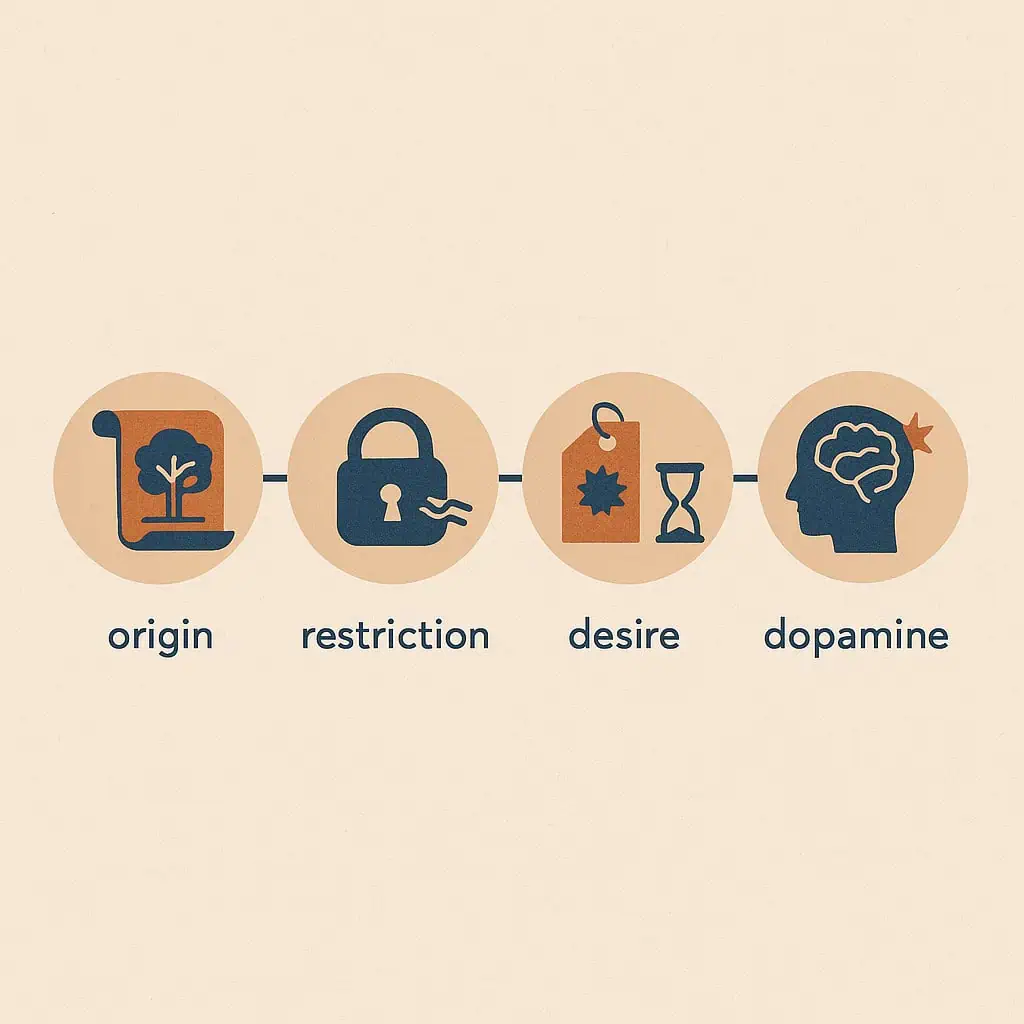
From old myths to modern marketing, people have noticed this urge for centuries. Stories of forbidden fruit and star-crossed lovers show how barriers can heat up interest. Later, social psychologists identified two key forces: scarcity, in which the rare feels valuable, and reactance, in which blocked choice makes us push harder.
Marketers then learned to use limited-time or limited-quantity cues to move crowds. Meanwhile, neuroscience found that dopamine neurons respond most strongly when the outcome is uncertain and surprising, not just when it is pleasurable. This helps explain why “maybe I’ll get it this time” can be so motivating.
Quick tour of reactance
Reactance theory holds that when our freedom feels threatened, we experience a surge of motivation to restore it. That “don’t tell me what to do” energy can make an option more tempting simply because it’s blocked.
Quick tour of scarcity
The scarcity principle shows up in sales, travel, and even dating apps. When something seems rare or running out, our brains treat it like a high-value target.
Quick tour of dopamine and uncertainty
Dopamine encodes reward prediction errors—the gap between what we expect and what we get—so uncertainty can feel exciting and pull attention.
So, why do people want what they can’t have? The 6 Reasons

Let’s put it together in plain language:
Scarcity turns “ordinary” into “special”
When access drops, our brains assign more value to the thing. Limited seats, sold-out drops, and “only 2 left” use this bias. Barriers signal value due to our fear of missing out.
Reactance: blocked freedom triggers push-back
Tell a teen they can’t see someone, and the attraction may spike. Tell a shopper, “You can’t buy this yet,” and interest rises. Limits feel like a threat to choice, so we try to reclaim that choice, sometimes by chasing the exact thing we were denied.
Dopamine loves “maybe”
Our motivation system is most active when rewards are uncertain. Slot machines and variable notifications exploit this; the “maybe” makes us check again. Likewise, the chance of getting the unreachable item or person can stir more wanting than a sure thing.
Distance lets fantasy do the editing
When we can’t have something, we fill in the blanks with best-case stories. The mind smooths rough edges, making a faraway option look flawless. That keeps desire alive, even when reality feels average. (Therapists see this pattern in unreachable crushes.)
Status and signaling raise the stakes
Sometimes the desired thing signals status—a rare bag, an elite club, an admired partner. The harder it is to get, the more it reflects on us, fueling desire. Marketers leverage exclusivity cues.
Culture keeps the loop spinning
Movies, music, and social media love the chase story. Because we see it everywhere, we start to expect it in real life, normalizing the pursuit of the unavailable and keeping the cycle going.
FAQs and Myth Busters
Is it normal to feel this way?
Yes. These are normal patterns, not flaws. Knowing the pattern helps you change it.
It’s all about “dopamine addiction”
Dopamine isn’t a “pleasure chemical”; it’s about learning and motivation, especially around prediction and surprise. It doesn’t make you doomed to chase; it just nudges attention toward uncertain wins. You can still steer your choices.
Does ”wanting” drop once we finally get the thing?
Often, yes. As mystery fades and prediction improves, the “maybe” energy fades. That’s why some thrills feel stronger before arrival than after.
How can I stop chasing the unavailable?
Two quick moves:
- Name the trigger (scarcity, reactance, status, fantasy). Labeling it lowers the urge.
- Add certainty or alternatives—clear rules, waitlists, or new goals. More options help break the fixation.
Does forbidding a relationship always make love stronger?
Not always. Early work found a “Romeo & Juliet effect,” but later studies are mixed. Sometimes outside pressure backfires; other times it pushes people apart. Real life is messier than the myth.
Bonus: Five surprising facts tied to the “can’t have it” effect
A loyalty card can speed you up near the finish line
People buy faster as they get closer to a reward (the goal-gradient effect). A coffee card with a head start gets finished sooner than one with the same number of punches left but no head start. Scarcity of “remaining steps” boosts drive.
“Limited time” really moves crowds
When brands honestly use real limits, demand often jumps. Scarcity cues don’t just sell—they shift perceptions of value, which is why the ethical use of the tool matters.
Parental bans don’t guarantee passion
That famous “ban makes love stronger” story gets retold, but follow-up work shows mixed or null results. It’s a reminder to be careful with sweeping claims.
Familiarity can increase liking, too
The mere-exposure effect says we often prefer what we see more of. So, while scarcity can fuel desire, simple familiarity can build steady liking—two forces that sometimes pull in opposite directions.
We often explain our choices after the fact
Studies on choice blindness show people can miss when their choice is swapped, then still defend it. This reveals how easily we can rationalize desire—even when the path to it was shaky.
Final word: why people want what they can’t have
Because scarcity, threatened freedom, and uncertain rewards team up with fantasy and status to overcharge our wanting circuits—and once you see that, you can choose differently.
Interested in exploring similar posts? Visit the Unspoken Psychology & Philosophy hub for more!