
Short answer: There isn’t one single meaning. In many places it’s a prank or rite of passage, sometimes it’s a low-key memorial for someone who died, and occasionally it’s linked to crews marking territory; however, claims about “drug house markers” are often exaggerated. Whatever the reason, don’t try to knock them down yourself—utility lines are dangerous.
Throwing shoes on power lines: background
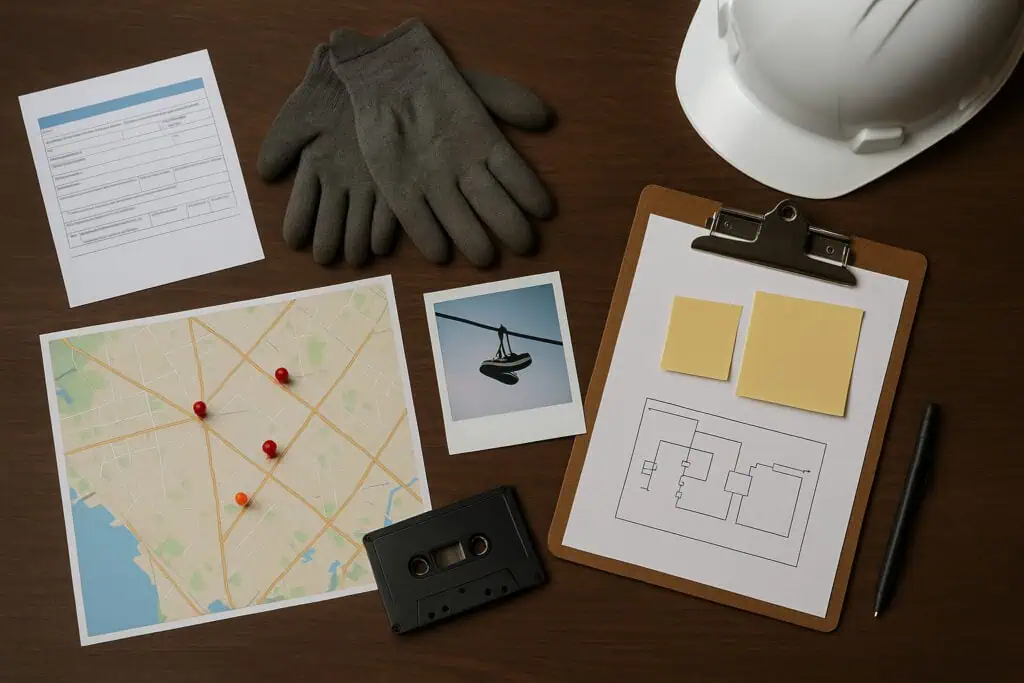
Before we jump into explanations, let’s set the stage. Newspaper blurbs, call-in radio shows, and neighborhood forums have puzzled over dangling sneakers for decades. Public radio reporters collected first-hand stories from residents, city workers, and former gang members to track where and when this shows up, even pulling 311 data on shoe removals in a major U.S. city to see how reports changed over time. Their takeaway wasn’t a single story but a patchwork of local traditions and street culture influences woven together by time and place, which is exactly why the mystery refuses to die (WBEZ’s deep dive maps the range of theories and data).
Urban-legend trackers have also logged the folklore for years, noting that the “secret code” explanation keeps spreading because it’s catchy, not because there’s one proof that fits everywhere. They stress that multiple explanations can be true, just not everywhere, all the time. Meanwhile, magazines and local papers keep revisiting the topic, collecting interviews from police spokespersons, residents, and utility crews; those pieces show how interpretations shift from town to town and decade to decade.
Why Do People Throw Shoes on Power Lines? The 5 Reasons

Now to the heart of it. There isn’t one meaning, but several common ones show up again and again:
Pranks, dares, and bored-kid bragging rights
The simplest answer is often the right one: kids test their aim, dare each other, or try to leave a mark in a place that’s hard to reach. People describe losing a bet, getting teased, or copying older kids. This matches many first-person accounts collected by reporters and locals alike.
A quick memorial
In some neighborhoods, a pair of shoes becomes a small public tribute after a death, especially when a friend died nearby. The shoes are visible, personal, and easy to place. Several community workers and residents told interviewers this was the most common “serious” reason they’d seen.
Rite of passage or life change
Graduation, finishing a season or camp, moving away, even leaving the service—these moments sometimes end with shoes tossed high and left behind. Culture writers have traced shoe-tossing as a recurring “I was here” mark that maps to specific youth traditions across eras (Snopes’ cultural context).
Territory and crew identity (but not a universal code)
Former crew members in some cities say hanging shoes once signaled “our block” or honored someone from the neighborhood. That exists, yet it’s inconsistent: in other cities the same object means nothing at all. Because signals need to be understood locally, this kind of meaning doesn’t travel well from place to place (on-the-ground accounts in Chicago).
The drug-house myth (and reality check)
The most famous claim says shoes mark where to buy drugs. It’s repeated so much that many folks assume it’s true everywhere. But when reporters asked police and researchers for proof, they found little that was consistent; several sources called it an urban legend or at least not a reliable sign. In short: it might be true in a few specific contexts, but it’s not a dependable rule.
Safety note: do not retrieve them yourself
Whatever the meaning, never try to yank shoes off a line. Powerlines can arc and kill from a distance, and rubber soles do not protect you. Utilities warn to stay away and call professionals instead.
FAQs: Throwing Shoes on Power Lines
Do shoes on power lines always mean gang activity or drugs?
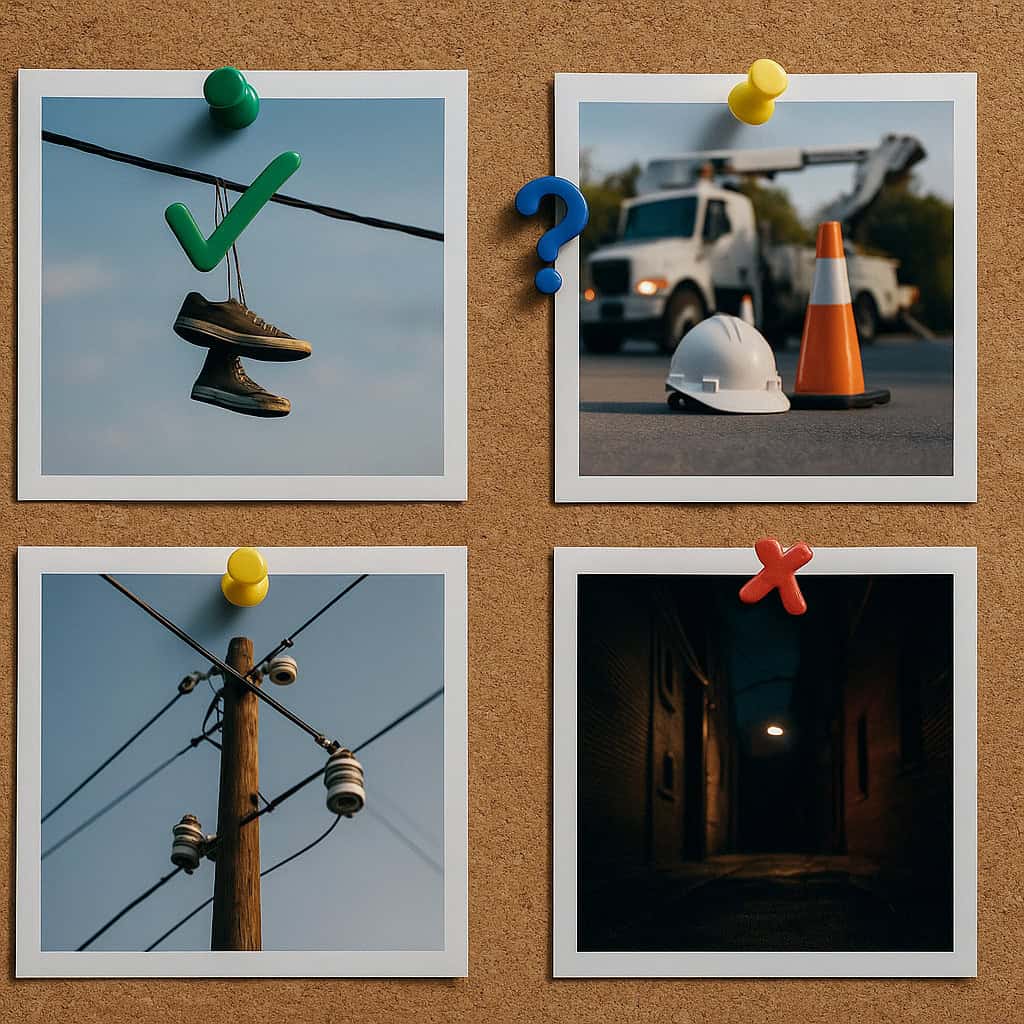
No. The idea is popular, but investigators and veteran myth-busters say there’s no single “code” you can read from shoes alone. In many places it’s pranks, memorials, or rites of passage, not a secret sign for buyers.
Is it illegal to throw shoes on power lines?
Rules vary. In some areas it can count as littering or criminal mischief, and cities sometimes log thousands of removal requests over the years. Even if your town doesn’t spell it out, utilities ask people not to do it because of cost and risk.
Are shoes on power lines dangerous by themselves?
The shoes aren’t the main danger—the lines are. Trying to hit or hook the shoes can bring you too close to live equipment. Utility safety pages warn that “rubber” gear won’t keep you safe around energized lines, so the right move is to leave them and report hazards.
Why do I see fewer shoes than I did years ago?
Some cities track and remove them, and some neighborhoods have simply moved on to different ways of making a mark. In one big city, requests to remove shoes dropped dramatically across several years as tracked by 311 data.
Bonus: fun facts related to shoes throwing

- The name “shoefiti.” People sometimes call the scene “shoefiti,” blending “shoe” and “graffiti.” The term pops up in folklore write-ups and pop-culture references that collect street-level traditions.
- Cities actually track these calls. Big metros have logged thousands of “remove shoes from wires” requests, which helps show where the habit clusters and how it changes over time.
- Local news keeps revisiting the story. From town papers to national magazines, recurring explainers appear because the meaning depends on context, so the answer “ages” as neighborhoods change.
- Utilities weigh in on safety more than meaning. Power companies focus on one thing: don’t go near lines. If you spot anything that looks hazardous, report it to the utility instead of trying a rescue yourself.
Final word (recap)
Why do people throw shoes on power lines? Because the act is simple and public, and it can carry many local meanings: prank, memorial, rite of passage, or sometimes a crew signal. The story changes from block to block, which is why one neat answer never fits. Whatever the reason, keep your distance and let the utility handle anything on the wires.
Interested in exploring similar posts? Visit the Hidden Histories & Origins hub for more!