
Short Answer: Tape measures are curved for a reason: Their blades’ curved (concave) cross-section turns a thin strip of steel into a stiffer, self-supporting blade. This allows the tape to “stand out” several feet without folding, making it much straighter, easier to use alone, and easier to read. The curve also helps the blade retract cleanly and resist kinks.
A short history of tape measures
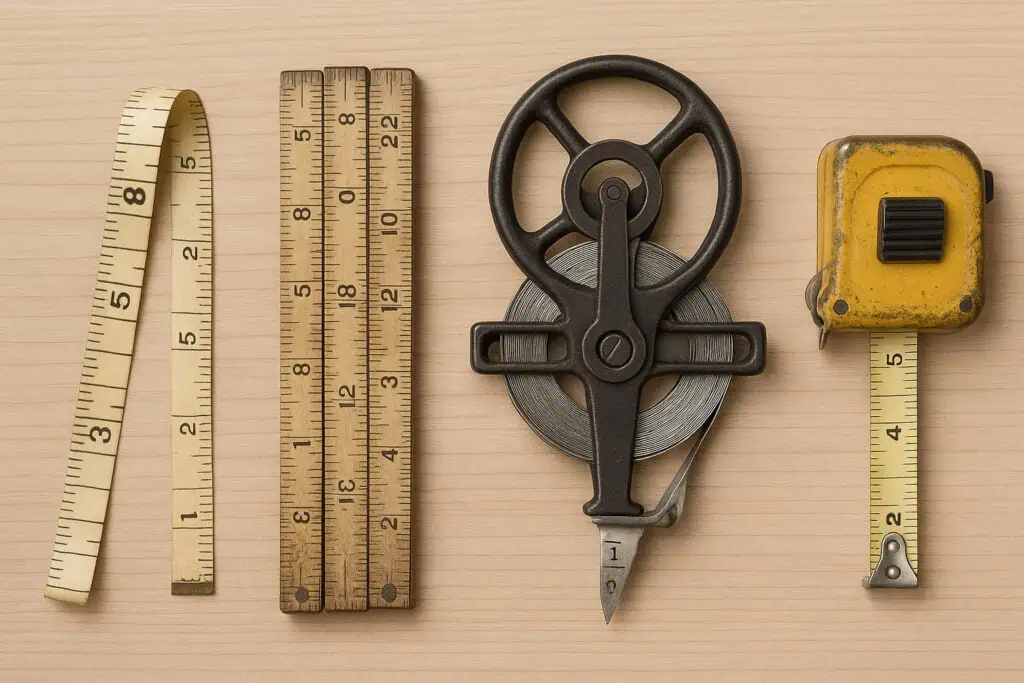
Before pocket tapes ruled the toolbox, people used cloth or steel survey tapes and folding rulers. In the early 1800s, Sheffield metalworker James Chesterman patented a spring method to rewind measuring tapes; later, long steel “band” tapes caught on with surveyors. In the U.S., William H. Bangs Jr. received a 1864 patent for a spring tape measure, and Alvin J. Fellows followed in 1868 with a click-lock design—closer to what we carry today. Only in the 1920s did a new concave-convex blade style begin to spread through carpentry, and from there the modern tape really took off.
Why are tape measures curved? The main reasons
The curve isn’t just for looks; here’s why it matters.
Stand-out and stiffness

A flat, thin metal strip buckles fast. The curve that strips across its width and the second moment of area (think “resistance to bending”) jump up, so the blade stays straighter under its own weight. That’s why your tape can “stand out” unsupported for many feet, which is crucial when you’re working alone. Brands even advertise stand-out/reach because it matters so much.
Fewer kinks, smoother retraction
Because the blade is curved, it wants to coil and uncoil in a controlled manner rather than flopping flat. That reduces sharp bends that can crease or crack the blade, and it helps the spring pull the tape back into the case smoothly. (Manufacturers and old patents describe concavo-convex blades as “self-sustaining” or “rod-like” when extended—exactly the behavior you feel in the hand.)
Easier to read and mark
Lay the blade on a surface, and that little arch gives you a “roof” that faces your eyes. Numbers are easier to see, and your pencil has a natural guide to scribe against. Many makers call this out as a side benefit of the curve.
Accurate work, inside and out
The curve isn’t what corrects for inside vs. outside measurements—the floating end hook does (it slides by the thickness of the hook, so both push and pull readings are true). Still, the curve helps keep the blade straight against edges so the hook can do its job.
FAQs: curved tape measures
What does “stand-out” (or “reach”) actually mean?
“Stand-out” is how far the blade can extend, unsupported, before it buckles. Some brands say “reach,” which often equals stand-out plus about 3 ft of assisted extension. Either way, a curved blade improves both.
Do all tape measures have the curve?
No. Tailor tapes and long open-reel survey tapes are flat because they’re meant to drape or pull under tension over long distances. The curved profile is a hallmark of spring-return pocket tapes.
Why is the end hook loose—did my tape break?
It’s supposed to move. The hook “floats” by roughly its own thickness, so you get the same reading when you hook an edge (pull) or press into a corner (push). This “true zero” feature is standard, and the curved blade helps keep the hook aligned.
Does a wider blade help more than the curve?
Both help. A wider blade raises stand-out, and the curved cross-section multiplies that effect. That’s why high-reach tapes pair a wide blade with a pronounced curve.
What do the black diamonds mean?
Those black diamonds around 19 3/16 in. help frame spacing for engineered floor joists; they align neatly with 8-ft (96-in.) sheet goods. Handy once you know.
Bonus: fun facts about tape measures
July 14 is “Tape Measure Day”
July 14, 1868, marks Alvin J. Fellows’ U.S. patent for an improved spring-click tape. Many celebrate it each year as Tape Measure Day—just for fun.
The 1922 patent that changed the jobsite
Hiram A. Farrand’s concave-convex blade patent (US 1,402,589, Jan 3, 1922) helped pocket tapes become a staple of carpentry in the decades that followed.
“Stand-out” vs. “reach” marketing
Tool reviewers note that “reach” is often just “stand-out + 3 ft.” Knowing this helps you compare apples to apples when you shop.
Final word: why tape measures are curved
In short, the curve turns a flimsy strip into a stiff, self-supporting blade that stands out, stays readable, retracts cleanly, and survives jobsite abuse. Once you feel how much easier solo measuring becomes, the design makes perfect sense.
Interested in exploring similar posts? Visit The Science of Everyday Life hub for more!
It’s amazing how such a small adjustment can make the tool so much more convenient.