
A lot of us assume a camel’s hump is a built-in water tank, like a canteen strapped to its back. But, as we are going to learn today, the hump has more to do with energy budgeting and other hidden truths than anything else. You will see clues in terms like adipose tissue, thermoregulation, and metabolic water, but the pieces only click once you follow how those forces work together.
Stories We Inherited
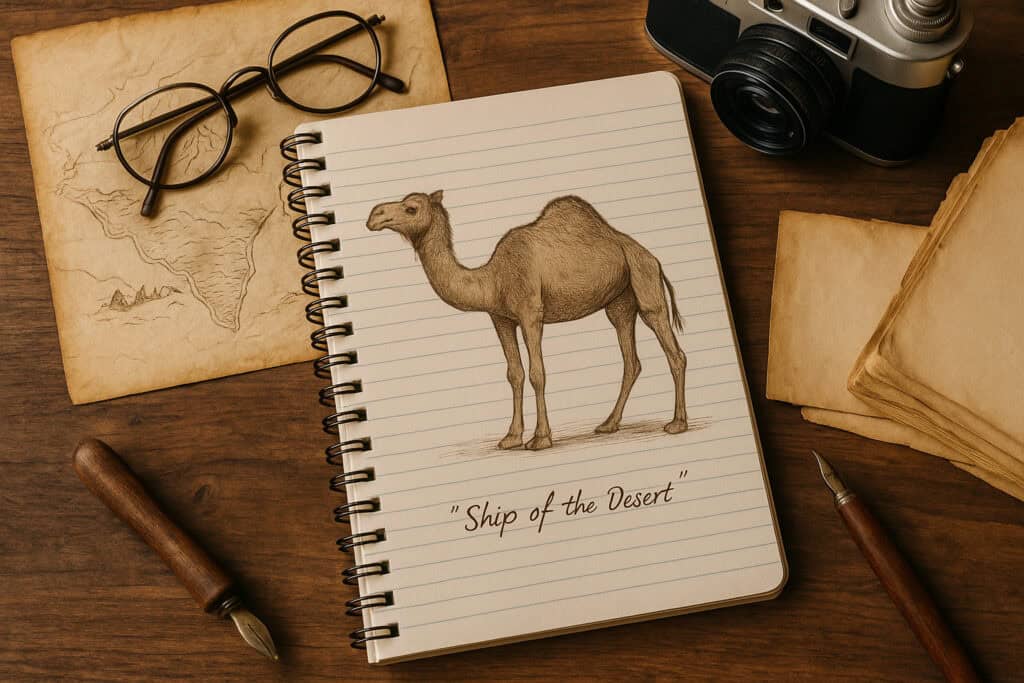
Long before science classes tried to explain it, people learned camel facts by watching camels do what other animals could not. Caravans crossed dry land where a mistake could kill you, and camels kept moving anyway. Over time, that stubborn endurance turned into a whole story about secret storage, because the hump looks like a container and the desert looks like a place where a container would help.
The “ship of the desert” idea is not just a poetic line, either. People have relied on camels for transport and survival for thousands of years, and modern animal profiles still describe how much they can carry and how long they can travel when resources are scarce.
Meanwhile, the water-in-the-hump claim became so common that it appears as a recurring question in public science education. When a myth is repeated for generations, it often stops feeling like a myth and becomes “obvious common sense.”
So the stage was set: a harsh landscape, an animal that survives it, and a body feature that looks like a storage unit. The real explanation, however, is not about what the hump resembles. It is about what problems the camel has to solve day after day.
A Back Built for Banking
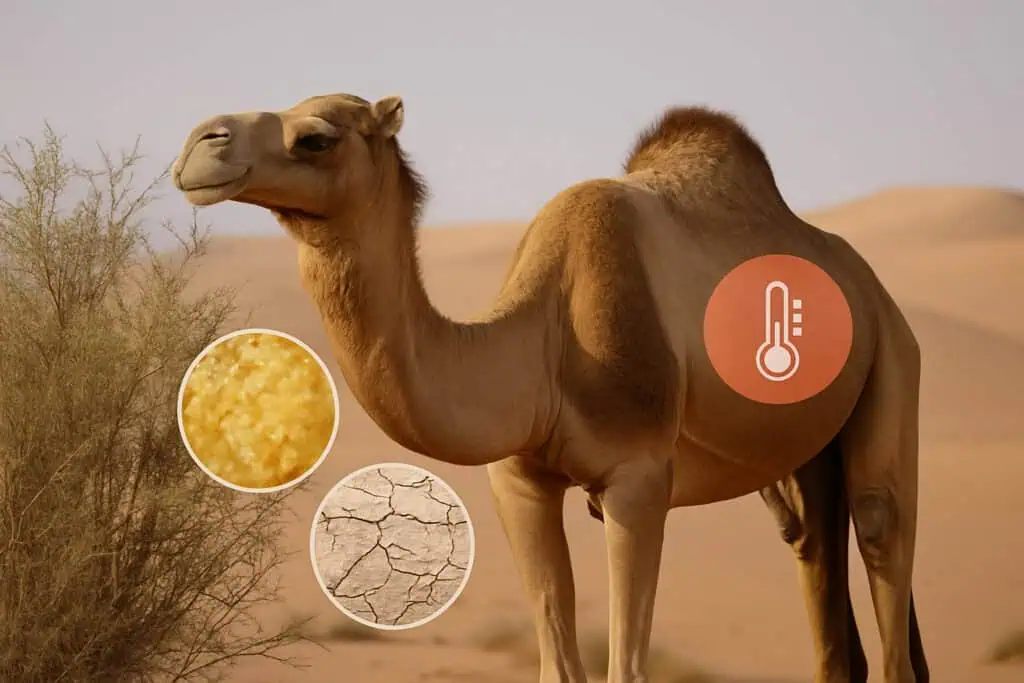
Adipose Concentration
Deserts are not empty, but they are inconsistent. One week you may find tough plants, the next week you may find almost nothing, and the distance between “meals” can be long. Because of that, survival depends less on eating a little every day and more on storing extra when you can, then drawing from it when you cannot.
That storage cannot be random, though. If energy reserves are spread throughout the body, the body carries that insulation everywhere too, and the animal pays for it in heat and sweat. If reserves are concentrated, the camel can keep most of its body leaner and cooler while still holding a serious emergency supply.
Only after you connect those dots does the main point become clear: the hump is primarily a fat reserve, a way to stockpile energy for the long stretches when food is unreliable.
Thermodynamic Insulation
Heat is a hidden tax in the desert. If an animal overheats, it must cool itself, and for most mammals that means sweating or panting. Yet both of those cost water, and water is exactly what you cannot afford to waste.
So the camel’s body has to manage heat like a careful spender. One helpful trick is to avoid wrapping the whole body in a thick layer of fat. Instead, by keeping a large portion of fat in one region, the camel reduces the surface area insulated, creating a thermal window for heat escape.
At the same time, a camel can tolerate a wider swing in body temperature than many animals. Because it can safely “store” some heat during the day, it does not have to start sweating as soon as the temperature rises. That delay matters because it saves water.
So, while the hump is not a radiator by itself, its location helps the camel run a more efficient heat strategy, reducing the need for water-intensive cooling.
Metabolic Water Chemistry
When people hear that camels can go a long time without drinking, they often imagine a hidden tank somewhere. Yet the camel’s endurance is more like a financial plan than a secret container. It uses what it has, it wastes little, and it leans on reserves when life gets tight.
Fat is not just “stored food.” It is energy that can be carried without constant eating and broken down when needed. Also, when the body burns fat, the process produces water as a byproduct.
Still, the key point is not “the hump makes water.” The key point is that the hump stores fuel that the camel can slowly tap into during scarcity, supporting survival when both food and water are limited. In other words, the hump is not a canteen. It is an emergency power bank, and the chemistry of using that fuel can slightly support the overall water-saving strategy described above.
The Status Signal
There is also a simple, physical reason the hump “looks like” something important: it is important, and it changes. When the camel is well-fed, the hump stands fuller. When the camel has been pulling from reserves for a while, the hump can shrink and even droop. That visible shift makes the hump more than storage. It becomes a signal of condition.
In real life, visible conditions matter because they affect how an animal moves through risk. A camel with good reserves can travel farther and push through lean periods, while a camel with a depleted reserve cannot. So the hump ends up being a kind of status display, not in a human social-media way, but in a survival way. You can observe that the “hump shape changes with reserves” idea discussed in common animal education materials, and it also shows up in public explanations of why hump size can change over time.
By the time you put all these pieces together, the anatomical logic is no longer mysterious.
Frequently Asked Questions

Do camels have “extra” water stored somewhere in the hump?
A hump can look like a container, so it is natural to assume it holds liquid. Yet the camel’s real advantage lies in reducing water loss and using stored energy wisely, not in carrying a hidden tank.
Does having two humps mean double the benefit?
Two humps mainly reflect different camel types and environments rather than a simple “more is better” rule. The same basic idea applies: reserves are stored up top, and the body draws on them when needed. The number of humps is more about species history and adaptation than a straight upgrade.
Why do some humps flop over?
Body reserves are not fixed objects; they are used and rebuilt. When the stored reserve drops a lot, the structure can lose its firm shape and lean or droop. When food returns, the reserve can rebuild, and the shape can change again.
Are baby camels born with humps?
Early life is more about growing the body than stockpiling backup reserves. As the young camel relies less on nursing and more on coping with seasonal scarcity, the hump becomes more noticeable. That timing lines up with the idea that the hump is a reserve for harder stretches, not a decorative feature.
Bonus: Fun Facts
Beyond the hump itself, the camel’s biology is full of specialised desert adaptations.
- Camels are increasingly discussed as climate-resilient livestock in some dry regions because they can withstand arid conditions where other animals struggle, altering local farming choices and food security conversations. WWF summarises this broader picture in its explainer on camel “superpowers,” including drought resilience and camels’ role in changing climates.
- A camel’s nose helps it waste less moisture than you might expect, because the nasal passages can help reclaim water from exhaled air. So, even breathing is part of the conservation strategy.
- Camel feet spread out like natural snowshoes, helping them walk on soft sand without sinking as much, and so they spend less energy per step.
- The “ship of the desert” reputation is not just about endurance. It is also about reliability: steady pace, heavy loads, and the ability to keep going when the landscape offers very few second chances.
Final Word
Never trust first impressions in nature. A feature can look like a container, a weapon, or a decoration, and still exist because it solves a quieter problem like heat, timing, and scarcity. That raises an interesting thought: the next time you see an animal ”oddity”, how many other body parts are not built for what they look like, but for the hidden trade-offs the environment forces every day?
Interested in exploring similar posts? Visit The Science of Everyday Life hub for more!