
”It is just a neat, old-timey look, like something copied from orchards or postcard towns,” someone would tell you if you asked them why tree trunks are all white. The real reason, though, lies in what happens when bark heats up quickly, cools even faster, and the living layer under the surface cannot keep up. Terms like sunscald, frost cracking, and cambium hint at what is really going on, but the pieces only click once you see how the trunk “experiences” light and temperature.
Old Coats, New Clues
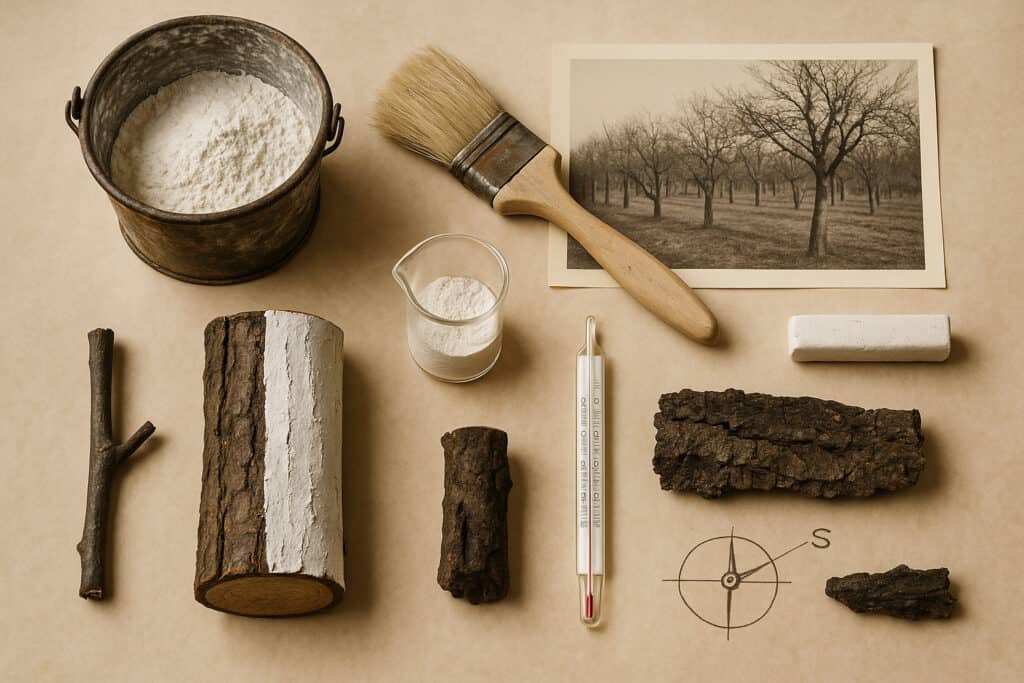
Long before anyone argued online about orchard aesthetics, people were already coating surfaces with pale washes. Lime-based whitewash was cheap, easy to mix, and widely used on farms, walls, and outbuildings. Over time, it became a familiar “clean” look, even when the goal was not only appearance.
Meanwhile, growers and gardeners built their own traditions through trial and error. In places with strong sun, sudden cold snaps, or both, people noticed patterns on trunks and big limbs, especially on the sides that catch the most afternoon light. As a result, advice began to spread from neighbor to neighbor, then from newspapers to extension services, and finally into formal guidance. One example is an older public Q&A-style note from Iowa State University Extension, which reflects how common the practice became in everyday yards, not just in commercial orchards.
Still, the “why” did not always get explained the same way. Some people framed it as a seasonal ritual, while others treated it like basic tree care, especially for young trees or trees that had been heavily trimmed. As a result, the look spread into neighborhoods, roadsides, and parks, even when the person holding the brush could not name the science behind it.
Light, Temperature, Living Bark
The Thermal Sponge Effect
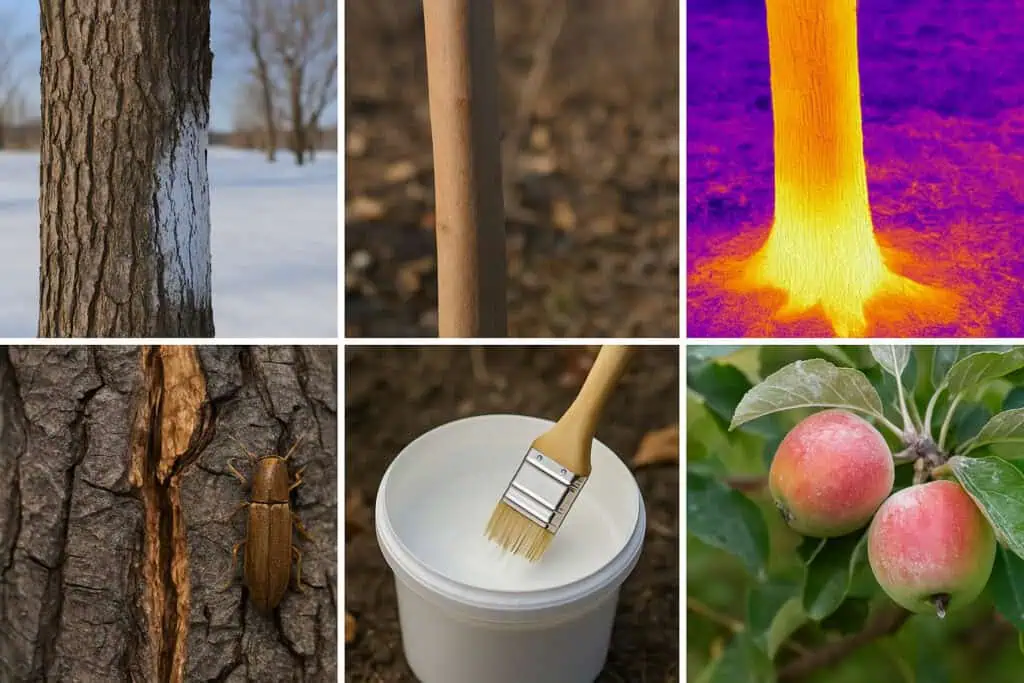
A trunk is not a dead pole, even if it looks tough. Under the outer bark, there is living tissue that reacts to heat and cold. Because darker surfaces soak up more sunlight, the sunny side of a trunk can warm up quickly on a bright day. Then, as the sun drops, the same spot can cool sharply. So, instead of the whole trunk changing temperature gently, one side can swing hard while the other side stays calmer.
That uneven heating matters because trees are built from layers, and layers do not warm or cool at the same speed. The outer layers respond first, while deeper tissues lag behind. Over time, those “fast-slow” changes can stress the trunk, just as bending a paperclip back and forth stresses metal. The pattern becomes even stronger in winter, when sunlight can be bright, but air temperatures can still drop fast.
Vascular Mechanics
Right beneath the bark is the part that keeps the trunk alive and growing. It is thin and sensitive. When it gets pushed outside its comfort zone, the damage can show up later as dead patches, peeling bark, or weak areas that struggle to seal. Even though the injury might look like a surface problem, the real trouble is often in that living band that helps move water and helps build new wood.
Because this layer is so close to the surface, the trunk behaves a bit like skin. It tolerates a normal range of heat and cold, but it can get overwhelmed by sudden, repeated temperature changes. That is why the timing of stress matters as much as the temperature itself. A steady cold stretch is often easier to handle than a warm afternoon followed by a fast freeze at night.
The Expansion Trap
Winter adds a special twist: the “thaw then freeze” cycle. When the sunny side warms, tissues can briefly emerge from a deep cold state. Later, when the temperature drops quickly, those same tissues can refreeze. That swing can contribute to cracking and splitting, especially in thin-barked species or in younger trees. Even if a crack looks dramatic, many trees can recover, although the split can become a weak spot.
In other words, the danger is not only cold. It is the back-and-forth, plus the fact that the trunk can be warm on one side and cold on the other at the same time. That uneven stress is one reason the problem tends to show up on the same sides of trees again and again, depending on local sun patterns.
Canopy Shock
Trees also get stressed when their own shade is removed. If a canopy is used to protect the trunk and big limbs, then heavy pruning can suddenly expose bark that has not “trained” for strong direct sun. That exposure can lead to overheating and tissue damage during hot spells, and it can also create a new hot-cold pattern on branches that used to stay cooler.
The detail that surprises many people is that this can happen outside the classic winter story. When a trunk or limb is newly exposed, the bark can take the hit in spring and summer, too, especially in bright, dry climates. That is why some pruning guides recommend protecting newly exposed wood on larger limbs.
Albedo Modification
Once you see the pattern, the logic becomes easier to follow. A pale coating alters how much sunlight the bark absorbs, keeping the surface cooler during sunny periods. Because the bark is not heating as high in the day, it also has less “distance” to fall at night. That means smaller temperature swings, which reduces stress on the living layer under the bark.
This is the core mechanical reason for the practice, even if neighbors explain it with different words. It is a simple way to make the trunk behave more like a reflective surface and less like a heat sponge. Extension resources describe this in practical terms, including what kinds of paint are commonly recommended and why. For instance, Utah State University’s discussion of “southwest winter injury” notes that some orchardists paint lower trunks with white latex to reflect light and reduce injury risk.
It is also worth noting what this approach is not. It is not a magic “tree medicine,” and it does not replace good planting, watering, and proper pruning. Still, because it targets the trunk’s surface temperature, it can be a surprisingly effective tool for a very specific kind of stress. Colorado State’s guidance on environmental disorders even mentions trunk painting as a practical protection method for commercial plantings.
Frequently Asked Questions
“It’s only for decoration, right?”
The look can be decorative, and that is why the practice spread into neighborhoods. However, the “clean white base” style tends to stick around most in places where trunks face strong sun and sharp seasonal swings. So, while aesthetics may be the visible reason, the underlying push usually comes from how trunks react to heat and cold over time.
“Any white paint works the same.”
Paints differ in additives and how they seal a surface, which matters for living bark. Many recommendations lean toward interior, water-based latex diluted with water, because it is more predictable and less likely to include certain chemicals used in exterior paints. The key idea is reflectivity without trapping moisture in harmful ways, and that is why guidance often gets specific about paint type and dilution rather than saying “grab whatever is in the garage.”
“Will this heal an existing crack or split?”
A crack is a wound, and the tree heals wounds mainly by growing new tissue around the edges, not by “gluing” the split shut. Protective coatings are usually discussed in terms of prevention, not repair. When damage has already occurred, some official guidance stresses that wound paints and tars do not help heal as people imagine.
“Does painting stop pests, too?”
Bark problems can attract insects, and stressed trees are more likely to become easier targets. Still, white coatings are mainly about changing the bark’s heat load, not acting like an insecticide. Some traditional mixes, especially lime-based ones, may create a surface that is less friendly to certain organisms, yet the main win most people are chasing is thermal protection, not pest control.
“Should every tree get painted?”
Risk is not equal across species, age groups, and locations. Thin-barked young trees, newly planted trees, and trees that were heavily pruned tend to be more vulnerable, while mature trees with thick bark often handle swings better. So, the practice makes the most sense when there is a clear stress pattern to prevent, rather than as a universal rule for every trunk on every street.
Bonus: Fun Facts
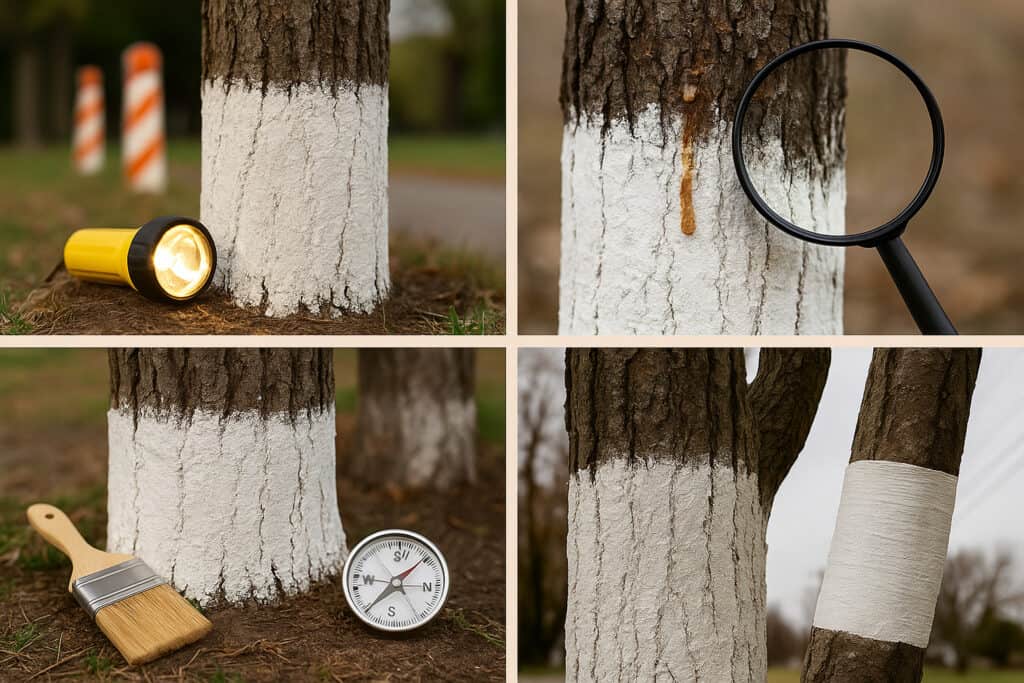
Beyond the orchard rows, the physics of reflectivity reveals a few hidden details.
- People often notice white trunks in orchards, yet the same idea shows up in surprising places. For example, severe pruning methods in some fruit systems can leave trunks and major limbs suddenly exposed, so protective coatings may be discussed as part of “rebuilding” a tree after a hard cut. The LSU AgCenter describes whitewashing in that context, noting its association with increased sunburn risk after heavy pruning.
- Reflectivity is a general tool in agriculture. Farmers use shade cloth, trunk wraps, and even reflective ground covers in some crops, all aiming at the same basic lever: change how much light turns into heat on a sensitive surface. So, when you spot the white paint, you are really seeing a low-tech version of a bigger idea.
- The practice can create a “false certainty” problem. Because the coating is visible, people may assume the tree is protected from everything and ignore watering, mulching, or proper pruning. In reality, the white layer targets a single narrow type of stress. It helps most when the rest of the care is already solid.
Final Word
At first glance, the paint appears to be routine decoration. But now that you have read this post, it reads more like a way to handle weather and light. This shift invites a broader question: how many “normal” sights in daily life are actually straightforward engineering, hidden behind “tradition”?
Interested in exploring similar posts? Visit The Science of Everyday Life hub for more!