
Most people think the side-to-side head movement is just a quirky way of saying “yes.” However, the real reason is more layered than a simple yes/no. In conversations across India, that motion plugs into “backchannel” behavior, classic “kinesics,” and even an old performance vocabulary called shirobheda—terms that hint at how the gesture works long before we try to label it.
Conversations in motion

Long before phones and email, people used posture, facial cues, and micro-movements to keep a talk flowing. Scholars bundle those signals under the study of body communication—what researchers call kinesics—because they regulate turn-taking, soften disagreements, and show attention even when no words change hands. In that bigger picture, the Indian head wobble sits alongside nods, shrugs, eye contact, and little sounds like “uh-huh,” all of which help a listener show presence without grabbing the floor.
Historically, head gestures diverge by region. While many places nod for “yes,” others flip the code, which reminds us that meanings are learned in communities, not wired in at birth. Research summaries on the origin and spread of head shaking underline that point by showing how few universals actually exist in gesture systems. All of that matters whenever someone asks why Indians wobble their heads, because the answer comes from how conversations are coordinated in real time, not from a dictionary definition.
Context before translation

Backchannel flow
In talk, listeners constantly feed tiny signals back to the speaker to keep the floor moving. Those micro-responses are called “backchannels,” and they can be a quick nod, a soft “mm,” or a brief head wobble that shows “I’m with you; keep going.” Once you see the wobble as a regulator of turn-taking and attention, the meaning stops being binary, and only toward the end of the moment can it settle into something like “I follow you, please continue.”
Degrees of agreement
Listeners don’t just signal that they’re engaged; they also signal how engaged. Motion size, speed, and rhythm shift responses from warm acknowledgment to enthusiastic buy-in. Fieldwork with Hindi speakers shows that bobbles and nods vary with commitment and role, so two wobbles can carry different weights depending on context; as the exchange winds down, they read as soft assent or stronger agreement.
Politeness and face-saving
In many Indian settings, social harmony and relationship-first communication matter as much as bare content. So a head wobble often cushions a response—showing respect, interest, or a provisional “okay” while the speaker finishes—before any firm stance appears. That means the gesture can feel like a gentle “we’ll work with this” for routine requests, and only near the end does it resolve into something closer to “yes,” “maybe,” or “not quite.”
Local rhythm, shared rules
Since the wobble is part of a conversation system, its meaning shifts across regions, ages, and situations—on a bus, in a shop, at home, or in meetings. It works best with tone, timing, and eye contact, which is why visitors who take it literally often get lost. Only after the surrounding cues land does the gesture line up with agreement or understanding.
Frequently Asked Questions
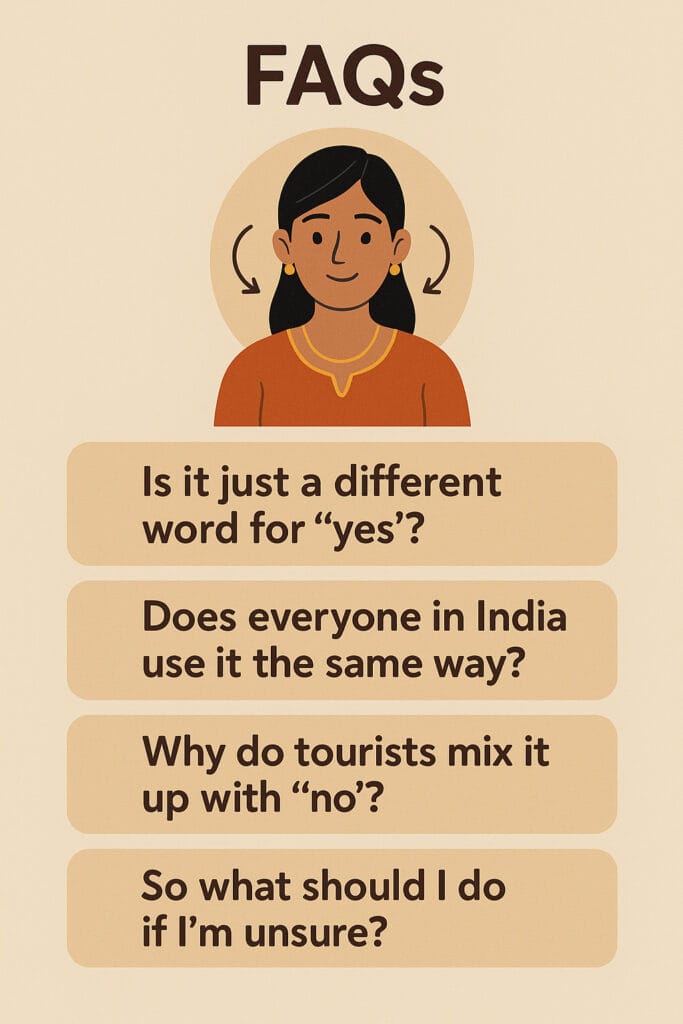
“Is it just a different word for ‘yes’?”
The gesture actually functions first as a listener’s signal to keep the conversation on track, meaning it often signals alignment long before it hardens into a commitment.
“Does everyone in India use it the same way?”
Cultures don’t move in lockstep, and neither do gestures. Regional habits, family norms, and the setting (friend chat vs. formal office) shape how often and how strongly people wobble. Because meaning rides on timing and tone, watching the whole exchange tells you more than the motion by itself.
“Why do tourists mix it up with ‘no’?”
When you bring a home rule—like side-to-side means no—you may misread a local signal. Head codes vary worldwide; some Balkan regions famously reverse nod/shake meanings, showing that the same motion can mean different things depending on local learning. This reminder helps Americans pause before translating the Indian wobble literally.
“So what should I do if I’m unsure?”
Lean on follow-ups that invite clarity without pressure: “Got it—should I go ahead as is?” Because the wobble often arrives mid-talk as an encourager, a friendly check at the end lets the other person convert it—if they want—into a clear yes/no.
Bonus: quick facts
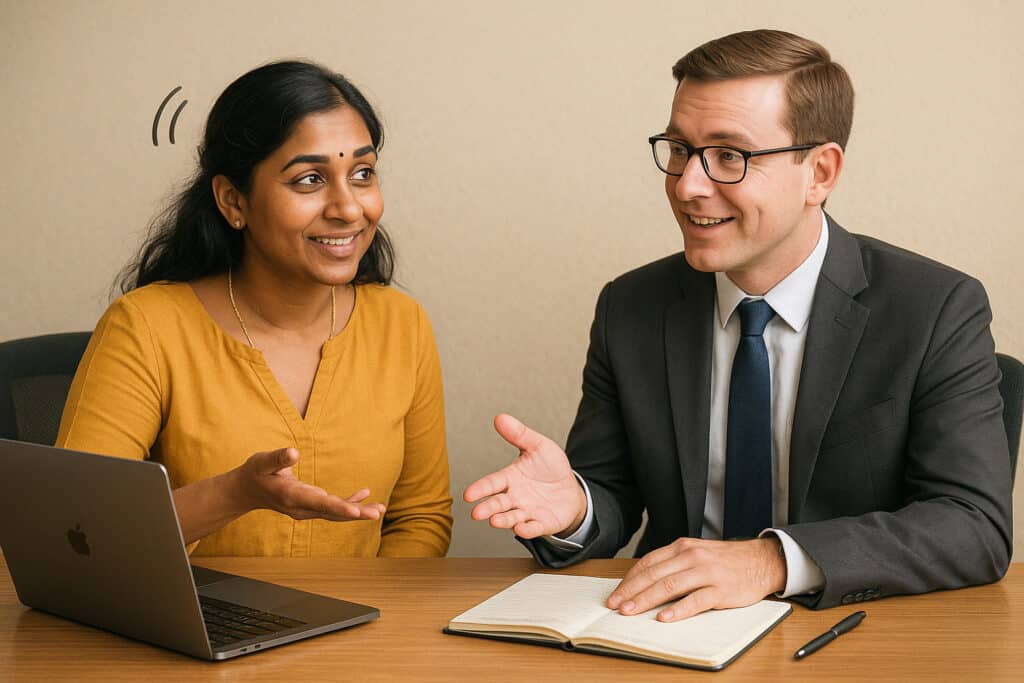
Beyond the main meaning, the mechanics of the movement reveal a few structural secrets.
- It shows up early in chats. Because the wobble often appears while the other person still has the floor, it’s usually an encourager rather than a verdict—more like the American “uh-huh” than a final approval.
- Intensity carries meaning. A quick, light wobble can read as “I’m tracking,” while a broader, faster one may feel like warmer alignment—yet the spoken wrap-up is what confirms it. Observational work with Hindi speakers illustrates those graded signals.
- It’s not monolithic. India is huge and diverse; many people never use the wobble at all. Repeating that Indians wobble their heads misleads more than it helps. The safest move is to match the person in front of you, not the stereotype.
Bonus 2: extra cultural notes
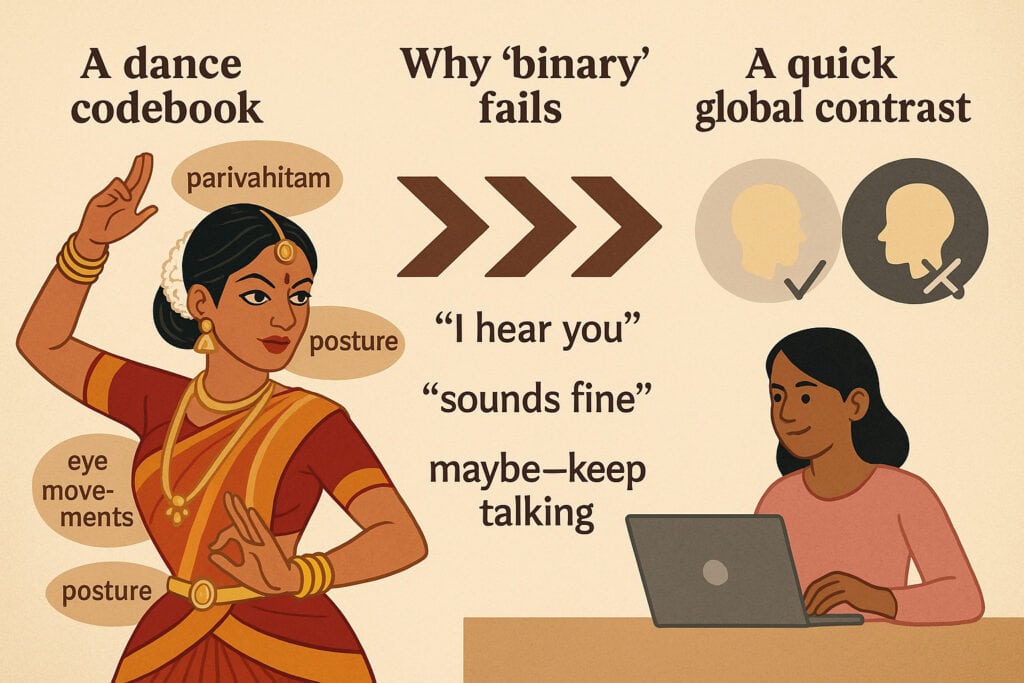
A dance codebook
Classical Indian dance codified head movements centuries ago in lists known as shirobheda. While performance gestures aren’t one-to-one with daily talk, seeing names like parivahitam (small, quick shakes) shows how finely head actions can be categorized and combined with eyes, hands, and posture. That long tradition reminds us the head isn’t just a “yes/no switch” in South Asian arts or life—it’s a full expressive instrument.
Why “binary” fails
Gesture meaning relies on motion, timing, gaze, intonation, and context. Since the wobble mainly regulates conversational flow, treating it as a word is a misstep. Backchannel cues help maintain alignment during conversations, so the wobble can mean “I hear you,” “sounds fine,” or “maybe—keep talking” based on context.
A quick global contrast
Even “universal” nods aren’t universal; some neighboring regions famously invert what a head move means. Remembering that global variation keeps Americans from force-translating the wobble into a simple “yes,” and it encourages listening for the sentence that often follows.
Final word
Treat the movement like a punctuation mark rather than a word. It keeps the dialogue smooth, shows engagement, and aligns participants in real time. Once you stop looking for a ‘Yes’ or ‘No’ and start looking for the rhythm, you become a much better listener—in India or anywhere.
Interested in exploring similar posts? Visit the Cultural Rituals & Society hub for more!