
Most people assume the saying sticks because cats are “magical” or “cheat death,” but the real reason behind the “nine lives” myth is simpler: it’s rooted in their unique physical abilities and the way stories spread across cultures. In fact, clues hide in ideas like the righting reflex, terminal velocity, and even the Egyptian Ennead—but we’ll come back to those.
From temples to taverns

Over the centuries, cats have earned a special place in human life. In ancient Egypt, they were linked with protection and home life, and the cat-headed goddess Bastet drew real devotion. Archaeology shows cat amulets, statues, and even vast cat cemeteries, which tells us people took cats seriously long before the legend about “extra lives” spread.
As stories moved west, the number 9 began to appear in writing. It pops up in English drama too: Mercutio famously mocks Tybalt by threatening “one of your nine lives,” which shows the phrase was already common by Shakespeare’s day.
Still, history alone doesn’t answer why people say that cats have nine lives. The next clue comes from what cats actually do with their bodies—and how that looks to us.
Survival systems at work
Airborne auto-correction
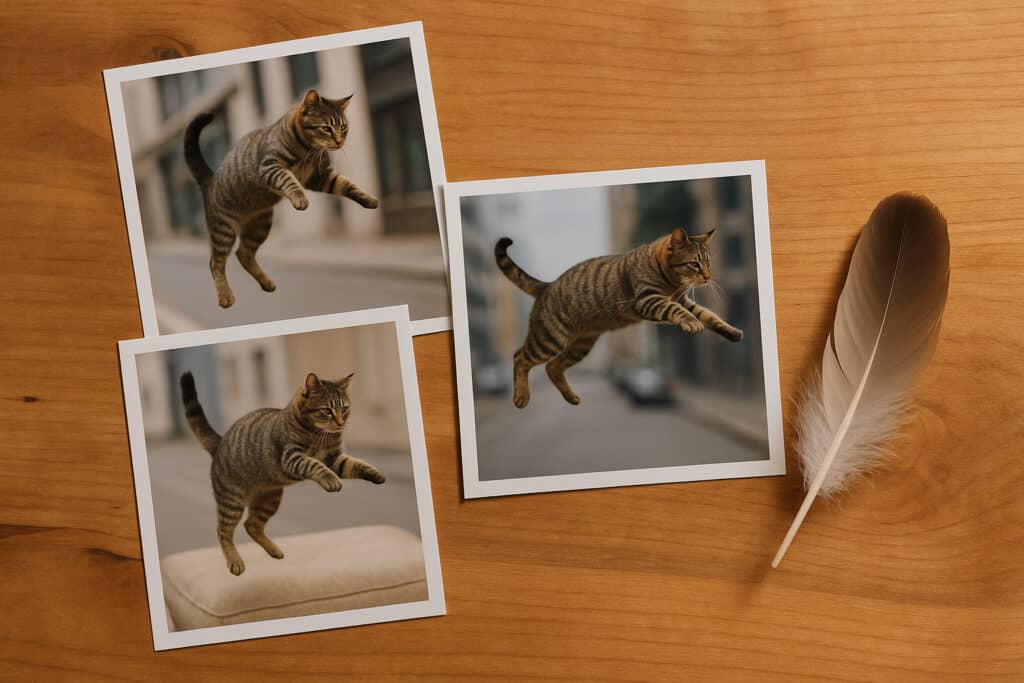
Inside a cat’s inner ear sits a tiny balance system (the vestibular apparatus) that tells the brain which way is up. The spine is unusually flexible, and the shoulders aren’t locked in place by a rigid collarbone. Because of that combo, a falling cat twists mid-air—head first, then shoulders, then hips—until the feet point ground-ward. Only after that whole sequence is the landing set up. This built-in move is called the righting reflex, and veterinarians note that most kittens perfect it by around seven weeks. When you watch that smooth turn, it feels like a near-miss with death. It’s this specific gymnastic ability that makes the survival story feel so believable.
Low-speed impact physics
A falling body speeds up until air resistance is strong enough to stop any further acceleration. That balance point is called terminal velocity. Because cats are small, can spread out like a little parachute, and carry less mass for gravity to yank, their terminal velocity is much lower than ours. In practice, that slower top speed can mean fewer catastrophic injuries than you’d expect—though it’s never “safe.” Seeing a cat walk away from a fall that would flatten a dog keeps the legend alive in everyday conversation.
Height and the injury curve
Emergency vets noticed a strange pattern when treating city cats that fell from buildings. In a classic New York study, injuries looked worse up to several stories, then sometimes less severe above that range—possibly because cats had more time to complete the righting reflex and spread out before impact. Although scientists debate details and bias, the headline experience—“I can’t believe the cat lived!”—spreads quickly and feeds the belief that cats have nine lives.
Number magic and memory
Long before hashtags, people loved tidy numbers. In Egypt, groups of nine gods (the Ennead) gave the number a sacred feel, and “nine” later stuck in many sayings. That stickiness matters because a shocking cat escape grabs attention, and a “nine lives” tagline makes it easy to remember and retell. As those escape stories spread, the habit of attaching a ‘lucky number’ to the survival rate became a permanent part of the folklore.
Frequently Asked Questions

Do cats always land on their feet?
Landing on the feet is a trend, not a guarantee. The righting reflex helps. Still, surface type, height, health, age, and even surprise all change outcomes. Because injuries can be hidden, animal-welfare groups urge a vet check after any big fall.
Is a higher fall somehow safer than a lower one?
What happens depends on many forces—air resistance, body position, and whether the cat had time to finish righting. Some data suggest injuries peak around mid-heights and look different at higher drops. That doesn’t mean a high fall is “safe.”
Where did the ‘nine lives’ myth originate?
Egypt shaped how people valued cats. The number nine had sacred weight in several traditions. Even so, the exact wording about “nine lives” shows up plainly in later English texts—Shakespeare included—rather than in a single Egyptian source.
Do all cultures believe cats have nine lives?
Culture picks a number that already feels lucky or complete. In Spanish-speaking regions, seven often plays that role. In parts of the Middle East, some sayings use six. The core idea is the same—cats skirt danger more than most.
If cats are built for falls, do I need to “cat-proof” windows?
A cat’s body helps, but hard ground, car parks, and balconies don’t. Screens, secured balcony netting, and closed windows save lives. After any fall, even when a cat looks “fine,” a vet check is smart because internal injuries can be hard to detect; the ASPCA outlines the basics.
Bonus: fun facts

The legend is catchy, but the actual science of falling has created a specific trail of medical terms and historical footnotes.
- Early scientists filmed falling cats to crack the mystery. Étienne-Jules Marey’s 1894 chronophotography captured the mid-air twist frame by frame. It changed minds about how cats turn without “cheating” physics.
- Veterinarians use the term “high-rise syndrome” for fall injuries because open windows and balconies lead to many emergency cases in warm months. That language keeps the focus on prevention rather than superstition.
- The righting reflex begins to appear in kittens as young as a few weeks old and improves with practice; flexible spines and a free-moving shoulder girdle enable the motion.
- Even with all that evolution, older, arthritic, or overweight cats don’t twist or absorb impact as well. That’s one more reason to treat the legend lightly and the safety steps seriously.
- Hearing the tale in different countries is a fun culture test: you’ll sometimes get “seven lives” or “six lives,” but the story always points back to the same talent—landing on their feet more often than not.
Final word
Once you see the gears behind the legend—a body that rights itself, physics that slows a fall, and a number that people love to repeat—the old saying stops sounding mystical and starts sounding human. We watch a cat tumble, gasp at the landing, and reach for a short story that fits the shock. The next time you hear the phrase, try flipping the question: what other everyday “miracles” are really clever biology plus memorable numbers?
Interested in exploring similar posts? Visit the Hidden Histories & Origins hub for more!