
Many assume tongue splitting is about “looking like a snake” or shocking others. The real reasons go deeper than aesthetics or rebellion—consider how bodies feel from within, how groups signal on the outside, and how rituals recast pain. Watch for three ideas as you read: proprioception, identity signalling, and legal boundaries—we’ll connect them once the picture is complete. If you’ve ever typed “why do people split their tongue” into a search bar, this is the fuller answer you probably hoped existed.
Early lineage

Before social media, modern body modification spread through zines, conventions, and small communities. In the late twentieth century, artists and experimenters helped turn scattered practices into a subculture, with magazines and performances that blended art, ritual, and personal exploration. That scene later reached film festivals and mainstream press, spotlighting figures who treated the body as a canvas and a question mark rather than a fixed object. Meanwhile, social scientists have mapped motivations and meanings across tattoos, piercings, and more extreme alterations in a broad review of body-mod literature—useful context for understanding how a forked tongue fits into the bigger picture of self-change and ritualized identity work.
Clinics and courtrooms

As the practice spread, medical voices weighed in on harm and safety, emphasizing bleeding risk, infection, airway concerns, nerve injury, scarring, and damage to teeth and gums. Professional bodies issued statements declaring that tongue splitting is a procedure classified as a “serious risk.” In some jurisdictions, this classification means tongue splitting is considered outside the scope of what non-clinicians or even clinicians may perform for cosmetic reasons. Specifically, in England and Wales, a Court of Appeal ruling (R v BM, 2018) confirmed that tongue splitting for cosmetic reasons is unlawful, aligning with warnings from dental and plastic surgeons about both legal implications and physical harms. Dental journals and news outlets echoed those concerns for clinicians and the public alike.
Important note: Laws and professional rules governing tongue splitting vary widely by region and may change over time. In many areas, even if adults consent, the procedure is not legally available outside closely regulated medical settings. The information provided is general in nature and should not be considered medical or legal advice; always consult current local laws and qualified professionals.
Layered motivations

The “Proprioception” Shift
Muscles, mucosa, and nerves in the tongue create a unique mouth “feel.” Changing the tongue’s shape changes how it rests, moves, and occupies space. Because perception follows anatomy, some report that a forked tip alters mouth-feel during everyday movements, then they match that inner change with an outer look. When sensation and design align, the modification stops being about shock value and becomes about internal coherence.
Costly Signaling Theory
Subcultures use symbols easily read by insiders. A visible forked tongue acts as a high-commitment signal—hard to fake and quick to recognize. Over time, the cost of the procedure acts as a filter, ensuring that everyone in the group is truly invested.
Reclaiming the Canvas
Changing the body can feel like reclaiming control. Choosing a permanent, dramatic alteration draws a clear before-and-after line, often reframing personal history as self-directed. An irreversible decision often serves as a permanent anchor for personal autonomy.
Mapping New Micro-Motions
The tongue is a precision tool for speech, breath coordination, swallowing, and play. Altering its tip alters how the two halves can move relative to each other, inviting experimentation with new micro-motions. Although formal research is limited and outcomes vary, the possibility of novel sensations and movements is part of the appeal, and that exploratory drive turns the mouth into a private playground for new sensory inputs.
The Tactile Interface
Because oral touch and temperature are rich, some people pursue modifications to enhance partnered intimacy or stage presence. The mechanism isn’t magic; two independently moving tips can introduce different contact patterns—real or perceived—which matters in settings where novelty and theater play a role. When personal expression meets performance, the modification acts as a tool to heighten connection in ways standard anatomy cannot.
Marking the Threshold
Ritualized pain often marks transitions, commitments, or values. For many, the act is less about the tongue’s shape than about marking a threshold—planning, enduring, healing, and displaying a visible reminder. When meaning is central, the fork becomes the ‘receipt’—permanent physical proof of a spiritual transition.
Frequently Asked Questions

Does a split tongue ruin speech forever?
Speech adapts because the brain remaps muscle coordination, but results differ. Some people adjust well; others note persistent changes, especially with fast or precise sounds. Long-term data remain limited. For a concise overview of the procedure and its risks, see this brief BMJ summary.
Is tongue splitting legal everywhere?
Legal status varies according to your location and who performs the procedure. Some regions allow only certain licensed professionals to perform the procedure, while others prohibit it completely. For example, in England and Wales, non-therapeutic tongue splitting by body-modification practitioners is unlawful following a 2018 Court of Appeal ruling and official statements from the Royal College of Surgeons. In the U.S., legal requirements differ by state and can fall under medical, dental, or general injury laws, so it is essential to check up-to-date local regulations before proceeding.
Is it safer if a piercer does it instead of a clinician?
Risks depend on anatomy and technique, not just skill. Complications in the mouth—such as bleeding, airway issues, infections, and nerve damage—can escalate quickly. Professional organizations advise against the procedure outside medical settings; joint guidance from surgical and dental groups details these hazards.
Can taste or feeling change?
Taste buds live in specific regions, and the lingual nerve provides sensation to the tongue; if tissue or nerves are affected, people may notice altered sensitivity, tingling, or numb spots. Changes can be temporary or persistent, and experiences vary widely.
Is a forked tongue the same as a naturally “cracked” tongue?
The distinction is anatomical. A fissured tongue is a benign anatomical variant with surface grooves and no cutting; it usually requires no treatment and shouldn’t be confused with a surgically split tip.
Bonus: quick fun facts
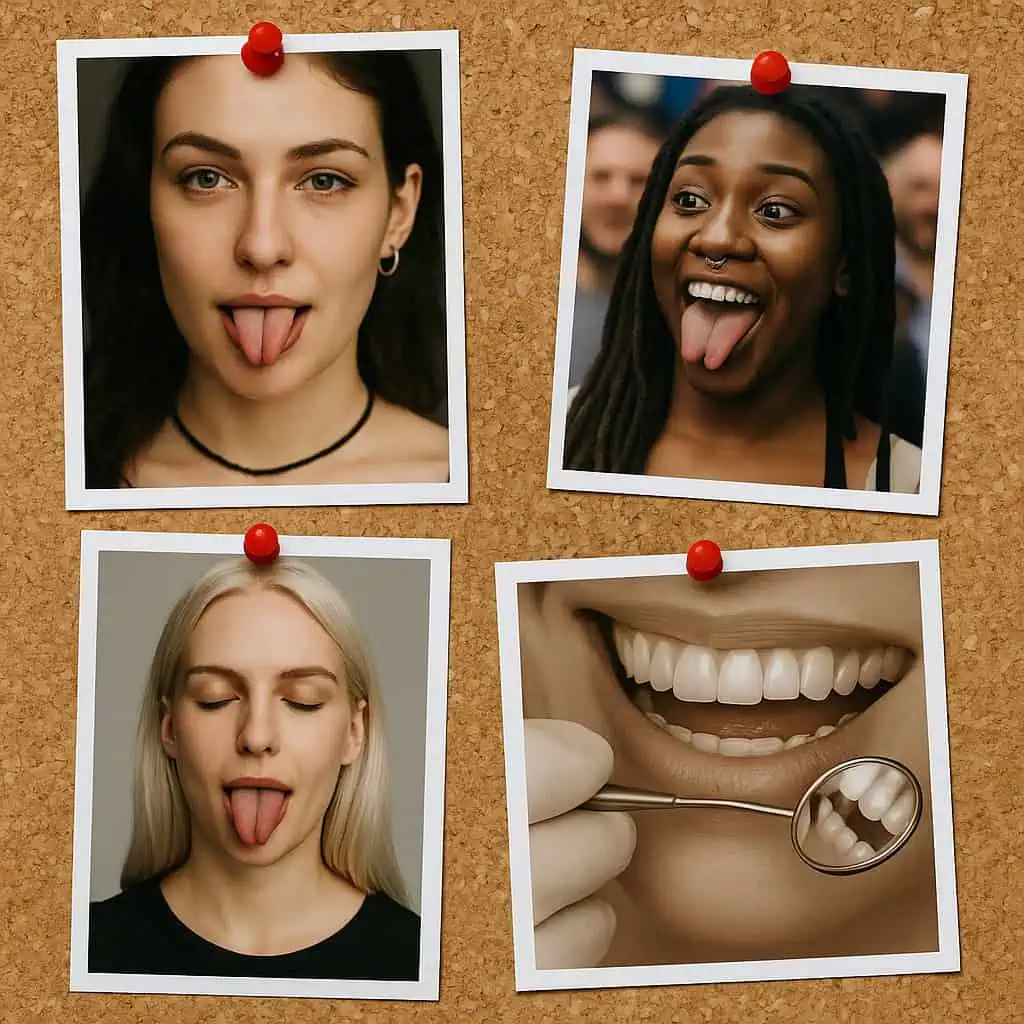
Beyond the medical warnings, the practice has created its own specific vocabulary and cultural footprints.
- Pop-culture moments: Body-mod documentaries and festival features helped normalize conversations about extreme adornment, showing how art, ritual, and community overlap in real people’s lives.
- Professional guidance: Dental and surgical groups have repeatedly flagged severe risks and, in some regions, legal barriers to non-therapeutic splitting.
- Not the only oral mod: Even everyday tongue or lip piercings carry gum and tooth risks over time, which is why mainstream dental guidance treats all oral body art cautiously.
- Look-alikes without surgery: Some people naturally have deep midline grooves or multiple shallow fissures that can appear like a fork in certain photos, but they’re harmless variants rather than a split.
Final word
Once you see the mix of sensation, signal, agency, and ritual at play, the question stops sounding like “Why would anyone do that?” and starts sounding like “What stories do we write on our bodies—and which communities read them?” Understanding that shift doesn’t require wanting the procedure; it just reframes the forked tongue as a lens on how people shape identity, seek belonging, and test the edges of what a body means.
Interested in exploring similar posts? Visit the Cultural Rituals & Society hub for more!