
Most people assume window candles are just pretty holiday decor or a quaint way to look “festive.” However, the real reason reaches deeper than decoration, pulling together old travel habits, quiet signals of faith, and a simple trick of light that makes a house feel alive. To get the real story, you have to look at an old travel hack and a way to send a message without saying a word.
Paths, laws, and light
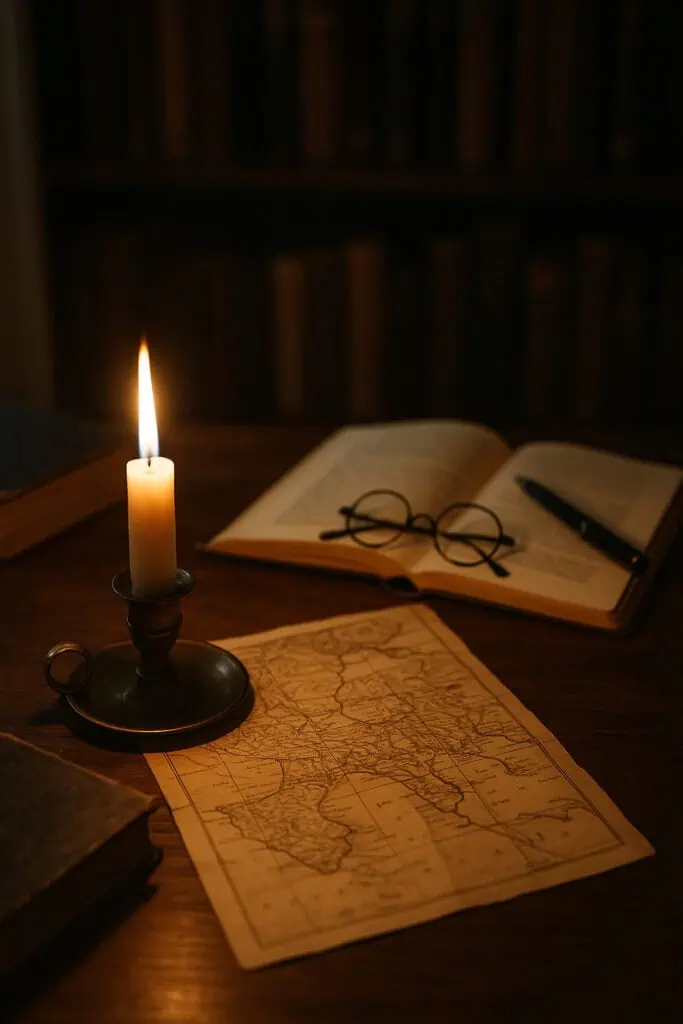
Before electricity, nights were truly dark. Travelers moved slowly, neighbors were far apart, and a small flame in a pane could act like a lighthouse on land. In parts of Ireland, the practice eventually folded into a Christmas custom—one candle set in the front window as a sign that a stranger could find warmth and food. Museums and historians still point to this link between light and welcome, including Irish accounts that connect the gesture to periods when Catholic worship went underground under the Penal Laws, turning a window candle into a soft code for safety and hospitality.
Other traditions shaped the glow, too. Jewish families often place a Hanukkah menorah by a window to “publicize the miracle”—a long-standing idea that the light should be visible beyond the home, even if history shows the practice shifted indoors in unsafe times. Across the Atlantic, early American towns later embraced candlelit windows as a seasonal sign of cheer and welcome; Colonial Williamsburg famously built an entire December aesthetic around warm light, greenery, and twinkling panes that turn streets into a living postcard (you can also check National Geographic’s look at Williamsburg).
Northern Europe adds yet another thread. In Scandinavia, St. Lucia’s Day cuts through winter’s darkness with candle processions and windows set aglow, a “festival of light” rooted in stories of courage and care. And in Denmark, people place candles in their windows on May 4 to mark the 1945 liberation from occupation—one night a year when the light carries a specific memory and shared relief. Over time, the idea of lighting a window became a flexible symbol: welcome, faith, memory, and community—each one bright enough to travel through glass.
Signals that still work
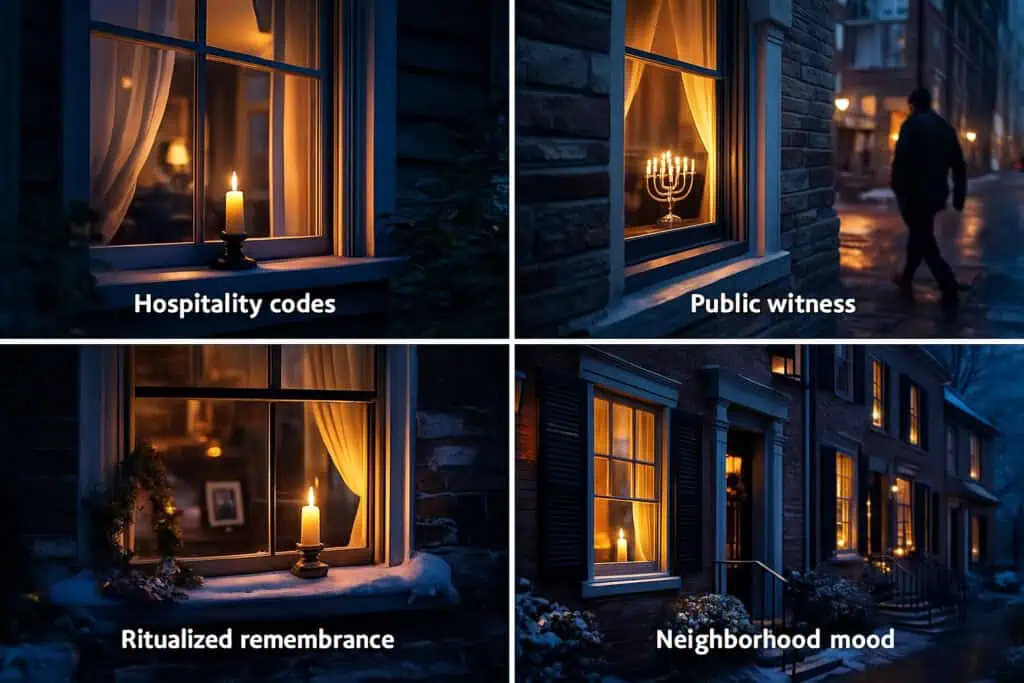
Hospitality codes
A home feels safe when it looks occupied, and a single flame does that instantly. Even an inexpensive, battery candle throws a human kind of light: soft, warm, and slightly moving. That glow makes a threshold look open rather than closed. In earlier centuries, that same “I’m awake, come in” message reached outsiders wandering at night. That old habit stuck around. It turned a survival signal into a simple, silent way of saying, ‘Come on in.’
Public witness
Rituals often work outward. Some practices are meant for the family around the table; others face the street on purpose. Hanukkah’s lamp near the window is a classic example: the light is arranged to be seen, not just felt. That “we believe this; we remember this” posture shows up in many faiths and local customs. Ideally, the light isn’t just for the people inside. It’s meant to spill out onto the street so everyone walking by gets the message.
Ritualized remembrance
Mourning and hope need markers. A quiet flame by the glass can mean a loved one is away, missed, or safely home. Communities also use window light to mark historic dates like victories, losses, and vigils. Because a single candle is low-cost and low-noise, it turns memory into something that people can do daily. It’s a quiet, cheap way to make sure a memory doesn’t fade out just because it’s dark outside.
Neighborhood mood
Light changes mood faster than paint. A faint gold flicker warms bricks and siding, and it helps a whole block feel less cold in long winters. The physics are simple: warm-colored light reflects gently and carries farther in darkness than you’d expect, especially against snow or pale walls. Once that optical trick kicks in, the whole block just feels a little less cold.
Frequently Asked Questions
“Isn’t it just a Christmas thing?”
Holiday timing is common in the U.S., especially in regions shaped by Irish and colonial customs. Yet the practice isn’t locked to December. Jewish families light candles for Hanukkah on dates that move with the Hebrew calendar, Scandinavians mark St. Lucia’s Day on December 13, and Danes commemorate liberation on May 4. Because different groups attach different meanings to the same simple act, the window candle shows up year-round in some places.
“Do real flames matter?”
History involved wax and wick, but modern homes often choose electric for safety and convenience. The symbol depends more on placement and visibility than on fuel; the “public” part is what counts. That’s why museum towns still lean into the look, even as most lights are electric (what your neighbor sees from the sidewalk is the point).
“Is the Irish origin the whole story?”
Irish traditions are a major source in American practice, strongly tied to hospitality and Catholic memory during times of repression. Still, window lights grow from multiple roots—immigration blended customs, and communities adopted what fit their calendars and streets. A single explanation misses the wider patchwork; hospitality codes, faith witness, and remembrance each feed the habit.
“What about Hanukkah? Why the window?”
The idea is to “publicize the miracle,” a principle called pirsumei nisa. By placing the lamp where the light can be seen, the home shares the story beyond its walls. Safety shaped the practice over time, but the window position remains common because the meaning looks outward as a feature, not a bug.
“Do window candles have any museum-level backing?”
Historic districts don’t just allow them—they stage them. Colonial Williamsburg’s December programming turns dozens of façades into a coordinated glow, teaching with light as well as text. That curated tradition helps explain how a once-practical practice became a seasonal identity in many American towns.
Bonus: Quick fun facts
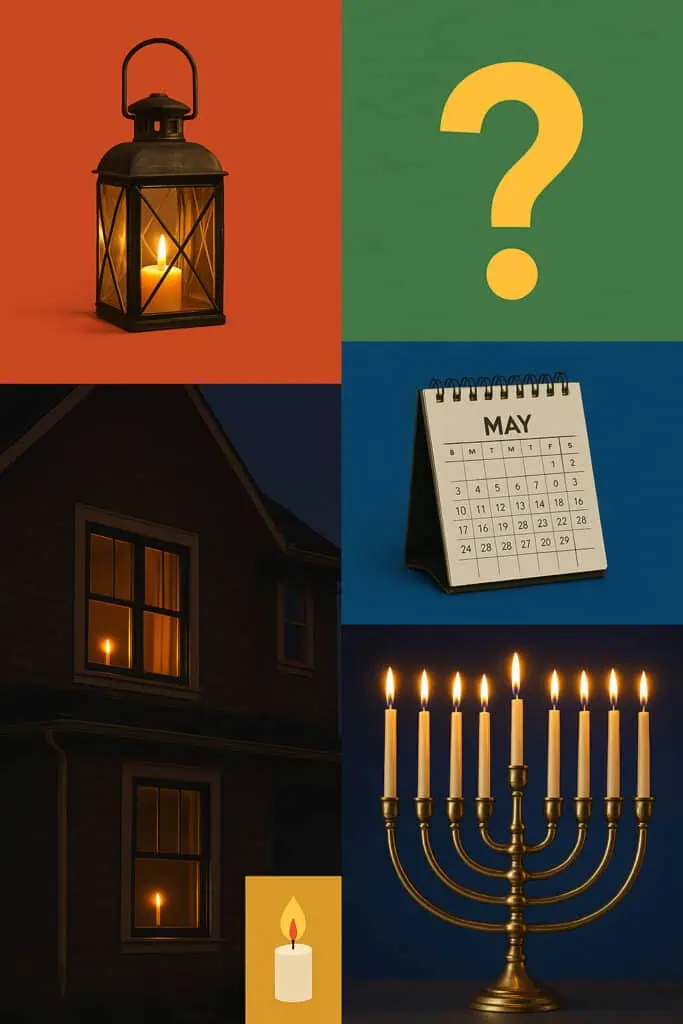
- A traveling code that stuck. The same cue that once helped strangers find an open door now works as a neighborhood handshake; a small lamp says, “someone’s home,” and that’s enough to change how a block feels.
- A story you can see. Some rituals ask for visibility by design. Hanukkah lights by the window and Lucia processions in winter both use public light as part of the message.
- A date on the calendar. In Denmark, a single night of window candles marks liberation in 1945, proving the same tool can carry a completely different meaning in another country and month.
- From flame to filament. Switching to electric didn’t erase the tradition; it made it safer and easier to scale. Public history sites and city main streets now rely on LEDs to create that old-world glow without the risk (the Smithsonian offers a broad holiday-lighting context for how electric light reshaped winter rituals).
Final word
A candle in a window looks tiny, but it works like a lever. With almost no effort, a home sends a message to the street, a family joins a chain of memory that crosses borders and centuries, and a neighborhood changes temperature without raising a thermostat. The next time you notice that small, steady glow, ask a bigger question than why people put candles in their windows. Ask what the light is doing (welcoming, witnessing, remembering, or simply warming the block), and you’ll start to see how a two-inch flame can carry a whole community’s voice.
Interested in exploring similar posts? Visit the Cultural Rituals & Society hub for more!