
Short summary: Fern dance is mostly a figure of speech. Ferns seem to “dance” because fronds unfurl as they grow (a curl-and-unroll process called circinate vernation), because young tips make tiny searching circles (circumnutation) and lean toward light (phototropism), and because wind or changing humidity can make fronds sway or even move dead fronds that help spread spores. A few water-clover ferns (Marsilea) even show real sleep movements at night (nyctinasty).
A short history of “moving plants”

People have watched plants move for centuries. However, the big push to study plant motion came in the 1800s. Charles Darwin wrote a whole book on plant movements and described the gentle circles many growing tips make, a pattern he called circumnutation. Later work confirmed that this helical motion is common across plant groups.
In ferns, one early and striking thing observers noticed was how each new frond starts as a tight coil and then unrolls. Botanists call this circinate vernation, and it gives us the classic “fiddlehead” shape in spring. Educational sources have used this as a textbook example for decades.
Meanwhile, lab studies showed that plant parts can turn toward light. This is phototropism, and it shows up in lower plants too, like mosses and ferns in their young stages, helping them aim their growth toward better light.
Scientists also explored plant movements tied to day and night. These are called nyctinasty or “sleep movements.” Many houseplants do this, but most ferns do not. One clear exception is the water-clover group (Marsilea), which raises and lowers leaflets between day and night.
Finally, newer research found that even dead fern fronds can move in response to changes in humidity. This helps time the release of spores on dry, breezy days, much like how pine cones open when the air is dry.
So, why do ferns dance? 5 surprising reasons
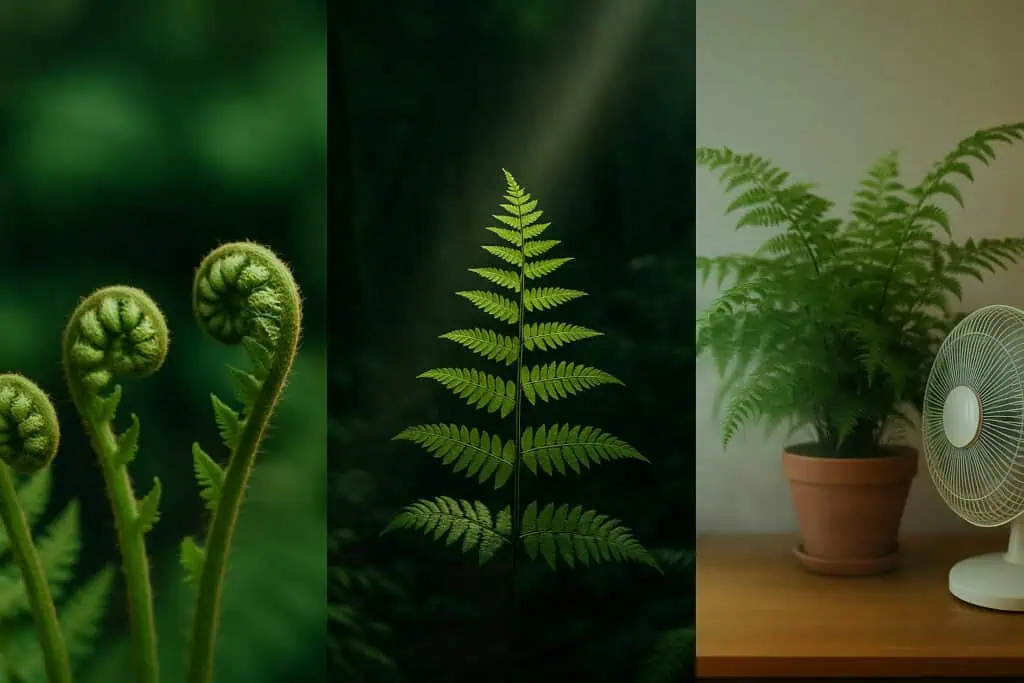
Growth unrolling is the core of why ferns ”dance”
New fern fronds start coiled and unfurl as they grow. Because different parts of the frond lengthen at slightly different times, you can see gentle, wave-like motion in time-lapse or even day to day. This growth pattern—circinate vernation—is a basic feature of fern biology and is the number-one reason they look lively.
Light-seeking and tiny circles make motion visible
Growing tips often lean toward light (phototropism). They can also trace small circles as growth shifts around the tip (circumnutation). These changes are slow, but across hours they create the feeling that the plant is “looking around,” which many people read as a dance.
Air movement explains the “living room waltz”
Because fern fronds are light and finely divided, air currents move them easily. A fan, heater, open window, or even people walking by can set fronds swaying. Therefore, what looks like a choreographed routine indoors is often simple airflow at work.
Humidity can nudge fronds (and even help launch spores)
Changes in humidity slightly swell or shrink plant tissues. In several fern lineages, dried tissues are built to bend with moisture, which can help time spore dispersal for drier weather, when spores travel farther. As room or outdoor humidity fluctuates, you may notice subtle bends.
True “sleep movements” are rare but real in one fern group
Most ferns do not raise or fold fronds at night. However, water-clover ferns (Marsilea spp.) do show daily leaf movements (nyctinasty) driven by a small joint (a pulvinus) at the base of each leaflet—similar to what you see in “prayer plants.”
Frequently asked questions about fern dance

Do ferns move at night?
Usually no. Most ferns don’t have nightly leaf-folding. However, Marsilea (water-clover) ferns do shift leaf position between day and night, a classic case of nyctinasty.
Is the fern in my house “dancing” because of light?
Partly. Growing parts can lean toward light (phototropism), so you may notice slow repositioning across days. For faster swaying in a bright window, airflow is the usual driver.
What is “circinate vernation,” and how does it relate to fern dance?
It’s the curl-and-unroll growth pattern of fern fronds. As the frond unfurls, different sections expand at different moments, which can look like a gentle wave in time-lapse—one big piece of the “dance.”
Do ferns respond to touch like the “sensitive plant”?
Not in the same way. The classic touch-me-not plant (Mimosa pudica) is not a fern and uses a special hinge (pulvinus) for quick leaf drops. Most ferns lack that mechanism, so they don’t snap shut or fold from touch.
Why do some ferns seem to “dance” even when they look dead?
Because dry tissues can still move with humidity. Research shows that dead fern fronds can bend back and forth as the air becomes wetter or drier, helping release spores at the right time.
Are there scientific names for the tiny circles I see in time-lapse?
Yes, circumnutation. Darwin described it, and modern studies still examine it in many plants, including ferns and their early stages.
Bonus section: Fun Facts related to ferns

Fern “fiddleheads” are more than a pretty curl
That coil has a purpose: to protect the tender tip while the rest of the frond extends. The familiar “fiddlehead” look is a direct result of circinate vernation.
Some fern stages feel light very differently
While adult fronds chase light in familiar ways, fern gametophytes (the tiny, early life stage) can show unusual phototropism, even moving away from certain light types.
Ferns use clever mechanics to spread
Beyond bending with humidity, many ferns fire spores with a tiny spring-like ring called an annulus. Although not the focus here, it’s another reason spore release pairs well with dry air. (General mechanism covered alongside humidity-driven movement.)
The “why ferns dance” idea fits a very old lineage
Ferns are ancient vascular plants. Consequently, the motions we observe today—unfurling, light-seeking, and humidity responses—arise from deep evolutionary solutions that predate flowering plants.
Final word: why ferns dance
Why do ferns dance? They grow by unrolling, they search and lean as tips respond to light, and they sway with air and humidity, with a special case where water-clover ferns truly move leaves by day and night. Put together, those slow and fast motions make fronds look alive, and that is the “dance” we see.
Interested in exploring similar posts? Visit The Science of Everyday Life hub for more!