
Short answer: Why penguins can’t fly comes down to trade-offs: over millions of years, penguins swapped flying through air for “flying” through water. Their wings became stiff flippers, their bones grew denser, and their bodies got bulkier and better insulated. These changes make them brilliant divers but far too heavy and short-winged for lift-off in air. Studies on related seabirds show that the better you make a wing for underwater power, the worse it gets for aerial flight.
A short history of penguins in science

Penguins go way back in time. The oldest known penguin fossils (such as Waimanu from New Zealand) are about 60–62 million years old, only a few million years after the dinosaurs vanished. Early on, there were even giant penguins taller than many people’s hips. Fossils like Kumimanu biceae show how quickly penguins took to life in the sea after their ancestors.
Fossils: the first penguins
Those early penguins already show the basic penguin body plan in the rock record. Researchers have pieced together this story fossil by fossil, noting how some features became more “penguin-like” through time. However, the earliest fossils still leave plenty of room for discovery about the steps in between. March of the Fossil Penguins
From giants to today’s 18 species
Over the ages, many species came and went. Today, there are 18 living species, all native to the Southern Hemisphere, from Antarctic ice to the tropics of the Galápagos. Even so, they are all seabirds that feed at sea and return to land to breed.
So, why can’t penguins fly? The Real Reasons
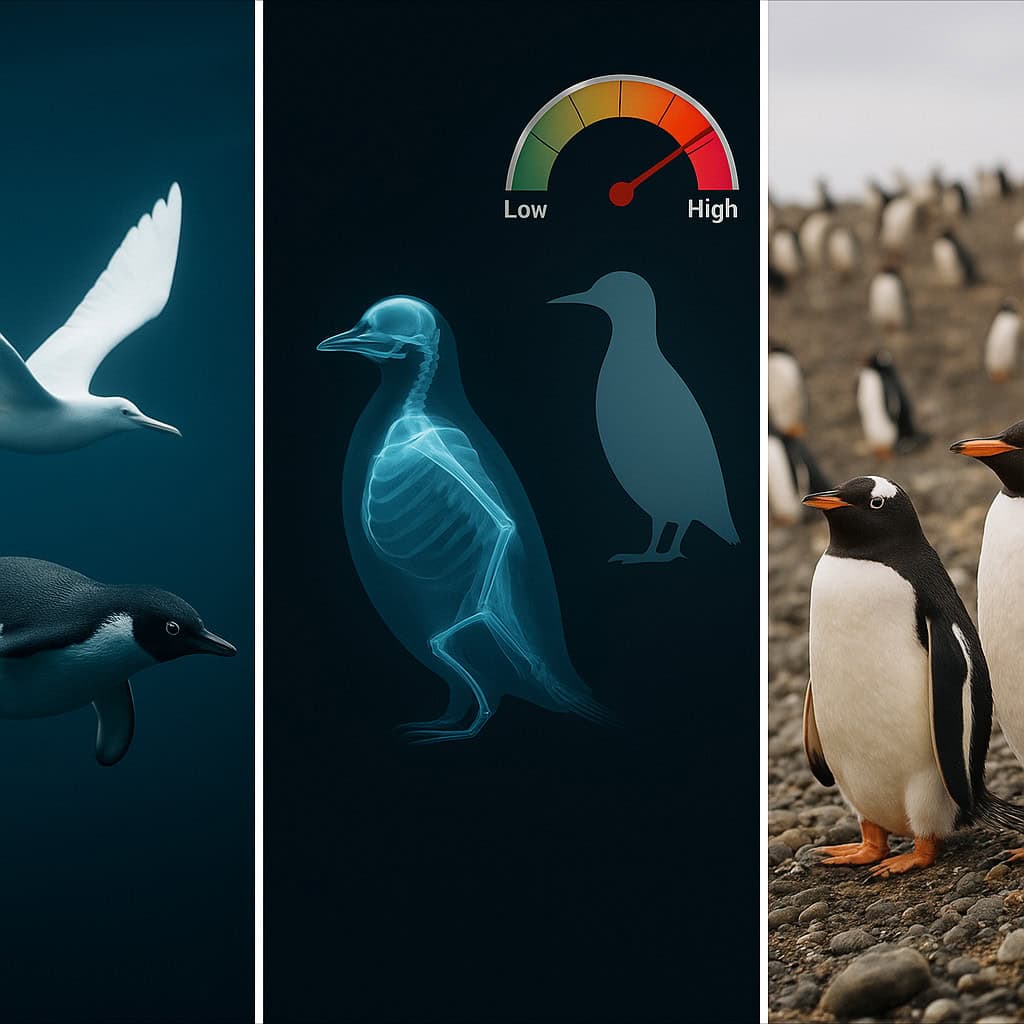
Wings turned into flippers
Water is thick compared with air. To move fast underwater, penguins use short, stiff, paddle-like wings that push on water with power on both the downstroke and upstroke. That same stiff, compact shape is terrible for flying in air, where you need long, flexible wings to make lift efficiently. In short, the more “flipper” you build into a wing, the less “airplane wing” remains.
Heavy bones, bigger bodies
Most flying birds have light, air-filled bones. Penguins, instead, have dense (osteosclerotic) bones that help them sink and stay stable at depth. They also carry thick muscle and fat for power and warmth. Together, that extra weight and density make take-off impractical.
Energy budgets and trade-offs
Flight is expensive. Scientists measured energy use in a close penguin relative—the thick-billed murre—and found that flying costs shot up when wings are also built for diving. As bodies get larger and wings get more “flipper-like,” the energy cost of flight becomes so high that flight drops out of the toolkit. Evolution then favors top-notch divers over mediocre fliers.
Safe on land, superb at sea
Because penguins feed at sea and nest in colonies on land with few land predators, they didn’t need flight for escape. Instead, selection pushed them to master the water. Over time, genes and body plans shifted toward powerful swimming and deep diving, not lift-off.
FAQs about why penguins can’t fly

Did penguins ever fly?
Penguins evolved from flying bird ancestors, but the oldest penguin fossils we’ve found are already flightless divers. The “in-between” steps happened earlier in lineages we haven’t fully discovered yet.
Why do penguins have wings if they can’t fly?
They do fly—through water. Their “wings” are flippers designed for underwater speed and control, not for air. The bones are fused and the flipper is rigid, which is perfect for swimming and poor for flapping flight.
Do any birds both fly and dive well?
Some, like murres and guillemots, fly in air and “fly” underwater with their wings. However, they pay a price: flying is very costly for them, and they’re not as efficient underwater as penguins. You can’t optimize one wing for both jobs without a big trade-off.
Is there a real video of flying penguins?
No. A famous BBC clip from 2008 showing penguins soaring over Antarctica was an April Fools’ hoax. Fun, yes—real, no.
Are penguins mammals?
No. Penguins are birds. They lay eggs, have feathers, and—despite the suit—aren’t related to seals or whales. All of them live in the Southern Hemisphere.
Bonus: fun facts beyond why penguins can’t fly
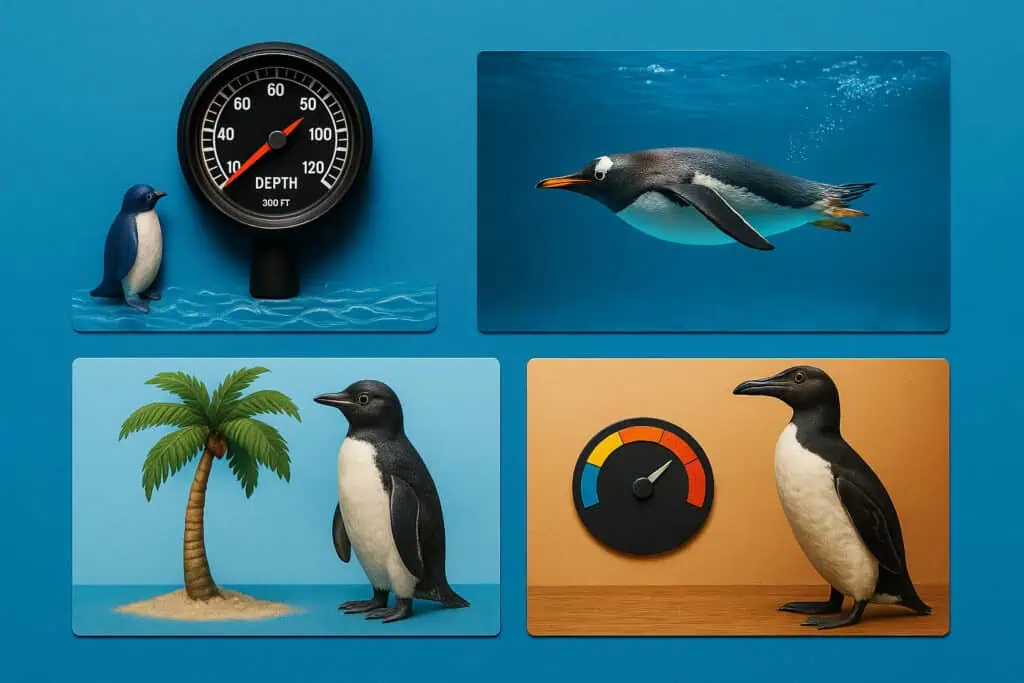
- Penguins are record-breaking divers. Emperor penguins have reached 564 m (1,850 ft) and can stay down for over 20 minutes, with exceptional dives near 27 minutes. Their bodies slow the heart, store oxygen in muscle, and keep going safely at depth.
- Some penguins are very fast “underwater fliers.” Gentoos can hit about 35–36 km/h (≈22 mph) underwater, slicing through the sea like torpedoes.
- Not all penguins live in the cold. The Galápagos penguin lives on the equator; many species breed on temperate coasts in the Southern Hemisphere.
- Where the name “penguin” came from is a twist. The word was first used for the great auk, a Northern Hemisphere bird that went extinct. Sailors later reused it for the look-alike birds down south.
Final word: why penguins can’t fly
In the end, why penguins can’t fly is a clear case of evolution choosing one path over another. By giving up flight in the air, penguins became unmatched pilots of the sea—winging through water with sturdy flippers, dense bones, and bodies tuned for depth and cold. That choice made them what they are: superb swimmers, not sky birds.
Interested in exploring similar posts? Visit The Science of Everyday Life hub for more!
No, they can’t lift off because they carry too much cuteness!