
Short answer (TL;DR): Many buildings skip labeling the 13th floor because of superstition and marketing. In most places, there’s no law forcing them to omit it; owners choose the numbering they believe guests and tenants prefer. Elsewhere, a different number (often 4) is avoided for similar cultural reasons. That’s the real story behind why there is no 13th floor on so many elevator panels.
Where did the 13th-floor superstition start?

Fear of 13 has existed for centuries in Western cultures. Historians disagree on one origin. Common theories link it to religious and literary traditions, such as the 13 at the Last Supper or Friday the 13th. Older European folklore adds to the mix. Scholars treat it as a cultural superstition, not a fact-based danger.
When tall buildings became common in the 20th century, developers noticed some customers disliked 13. As a result, they began renumbering the 13 as 12A, “M,” or skipping straight to 14. Elevator makers soon reported that many panels left out the “13” button.
Do buildings have a 13th floor?
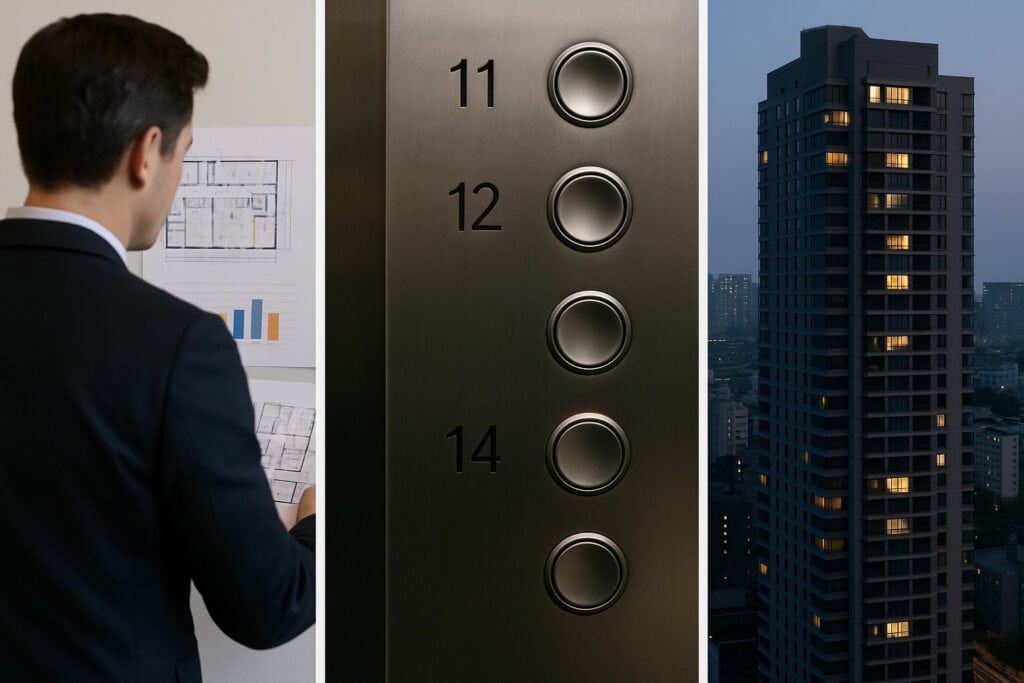
Do hotels have a 13th floor?
Many hotels drop the “13” label to avoid guest complaints and lost bookings. On the other hand, others keep it, including some chains and historic hotels. In short, the choice is about branding and guest comfort, not regulation.
Do elevators have a 13th floor?
Elevator panels reflect the building’s floor labels. In many cases, Otis has noted that high-rise panels skip “13,” sometimes replacing it with 12A or “M” (the 13th letter of the alphabet).
Does the Empire State Building have a 13th floor?
Yes. NYC real estate sources confirm the Empire State Building lists a 13th floor. That said, historic and tenant directories may change over time, but this shows “13” is not always skipped.
Did the World Trade Center have a 13th floor?
Yes. The original Twin Towers were labeled on the 13th floor, and One World Trade Center includes 13 today. Even so, many lower floors serve as a lobby or mechanical areas, but no law forbade “13.”
Why isn’t there a 13th floor in other countries?
Canada
Many hotels and residential towers in Canada omit or relabel the 13th floor for guest comfort. However, Vancouver changed course in 2015, requiring sequential floor numbers so first responders aren’t misled.
Australia
Some projects skip 13. In developments targeting East-Asian buyers, 4 and even 14 or 24 may be omitted due to tetraphobia. Local press has covered towers that drop 4 and 14 from panels for market appeal.
The United Kingdom
The UK has no law against it. However, some hotels skip floor 13 or room 13 to avoid complaints. The superstition also appears in addresses; several London streets lack a house numbered 13.
Ireland
Like the UK, Ireland leaves it to the property owner. As a result, many hotels avoid labeling floor 13 or room 13 as a business choice.
Singapore and Hong Kong
Here, “4” is the unlucky number. The word sounds like “death” in several local languages. Because of this, buildings often skip 4, 14, and 24. In mixed-culture towers, both 13 and 4 may be absent. Hong Kong even has towers that skip the entire 40s.
India
In cities such as Mumbai, Pune, and Hyderabad, many developers omit the 13th floor in condos and hotels because buyers prefer it. Media reports show it’s a common market habit, not a legal rule.
Other Frequently Asked Questions
If 13 is skipped, is the “14th” floor really the 13th?
Physically yes. Only the label changes; the stack of levels doesn’t.
Do engineers skip floor 13?
No. The owner or developer decides how floors appear on labels, often with input from architects or branding teams. Engineers design the structure as a continuous set of levels. The 13th level still exists physically. In NYC, high-rise owners must disclose non-sequential numbering—like skipping 13—on their Fire Department Building Information Card.
What is triskaidekaphobia?
It’s the superstition or fear of the number 13, often cited in discussions about missing 13th floors.
Interested in exploring similar posts? Visit the Hidden Histories & Origins hub for more!
Triskaidekaphobia?! I couldn’t even pronounce it! Thanks for some interesting info.